Blog
AI photo booths, avatars and kiosks: what your brand must tell the public
Article 50 of the EU AI Act already applies and the last extension ends on 2 December. What that means for an experience on a stand, and how to make the notice part of the design.

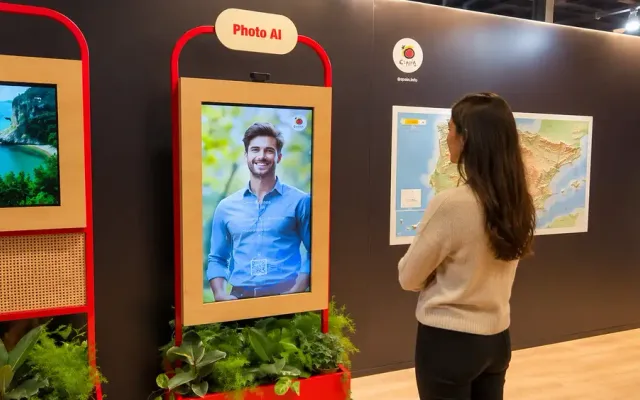
A visitor takes a photo on a stand and, seconds later, sees themselves in a cove they have never set foot in. They love it, download it through a QR code and post it. They know it is AI. The people scrolling past may not.
Two aisles along, a kiosk answers questions with a warm voice and a friendly face. Is that a person on a remote link, or a machine? If the doubt is reasonable, there is already a design problem.
Telling people that AI is involved is no longer a legal footnote: it is an experience decision to make before anything gets built. This article sets out our practical reading as a studio, not legal advice.
What already applies and what ends on 2 December
Article 50 of the EU AI Act has applied since 2 August 2026. On 20 July the Commission adopted guidelines with very concrete examples. They are not binding, but they are the best reference available.
The 2 December 2026 date is narrower than it is often made out to be. According to those guidelines, it only gives breathing space to providers of generative systems already on the market before 2 August, and only for machine-readable marking. Telling people they are talking to an AI gets no extension, even in mixed systems.
Content generated before 2 August does not need retrospective labelling. For everything else, Article 99 sets fines of up to €15 million or 3% of worldwide turnover, with SMEs subject to the lower of the two.
Who answers for it: provider, brand and agency
The guidelines separate two roles. The provider develops the system, or modifies it and puts it into service under its own name. The deployer decides what it is used for and how, even without controlling the technology.
A brand that merely commissions an advert from an agency, without deciding whether or how AI is used, is not a deployer. But the guidelines do not let that role dissolve either: whoever holds it must make sure the label reaches the audience visibly, for example through contracts and interfaces.
So it pays to put in writing, before the event, who supplies the system, who decides its use and who signs off each notice.
Kiosks and assistants: say it before the first question
A chatbot, voice assistant or avatar must disclose that it is AI unless that is obvious. That exception is read restrictively: if the general public can reach it, including children or older people, it is best not to rely on it. An open trade fair or a hotel lobby is exactly that case.
Imagine a digital point like Placely, which answers guests' questions using language models. The start screen is the natural place to say so in plain words: "I'm the hotel's AI assistant."
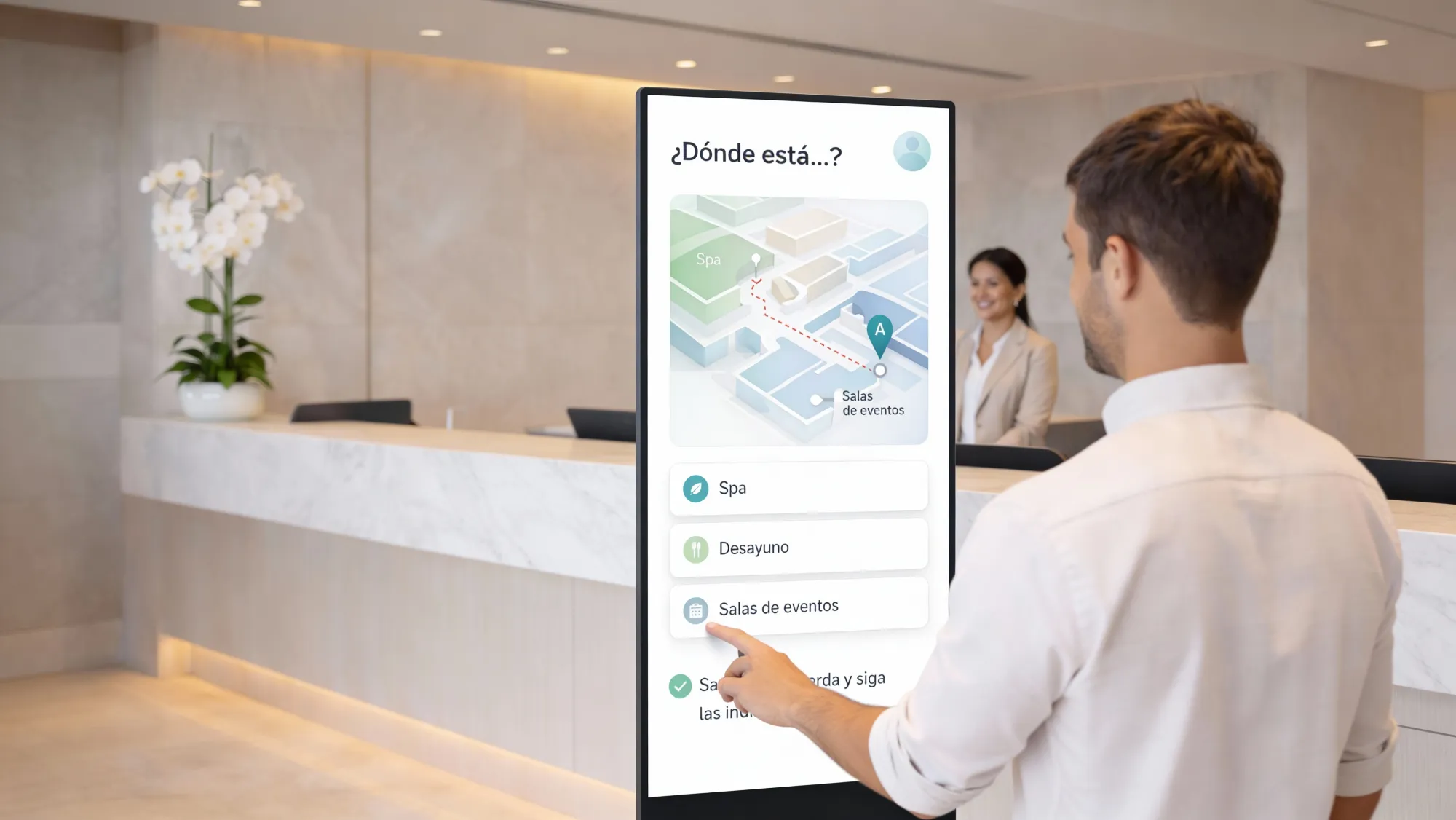
The guidelines rule out several approaches as the only notice:
- A mention in the terms of use or behind a URL.
- A watermark or metadata that nobody perceives.
- The bare word "assistant", or a human character that confuses people.
- A generic "this service uses AI" or a technical "powered by LLMs".
A single prominent notice before starting will usually do. Immersive or long-running experiences, or those involving vulnerable people, may need reminders. And if someone asks "are you a person?", the system has to answer truthfully.
AI photo booths: when the image needs a label
This is where the definition of a deep fake matters: content that resembles real or plausible people, objects, places or events and would falsely appear authentic. The guidelines do not require an intent to deceive, and they make clear that buildings count as objects.
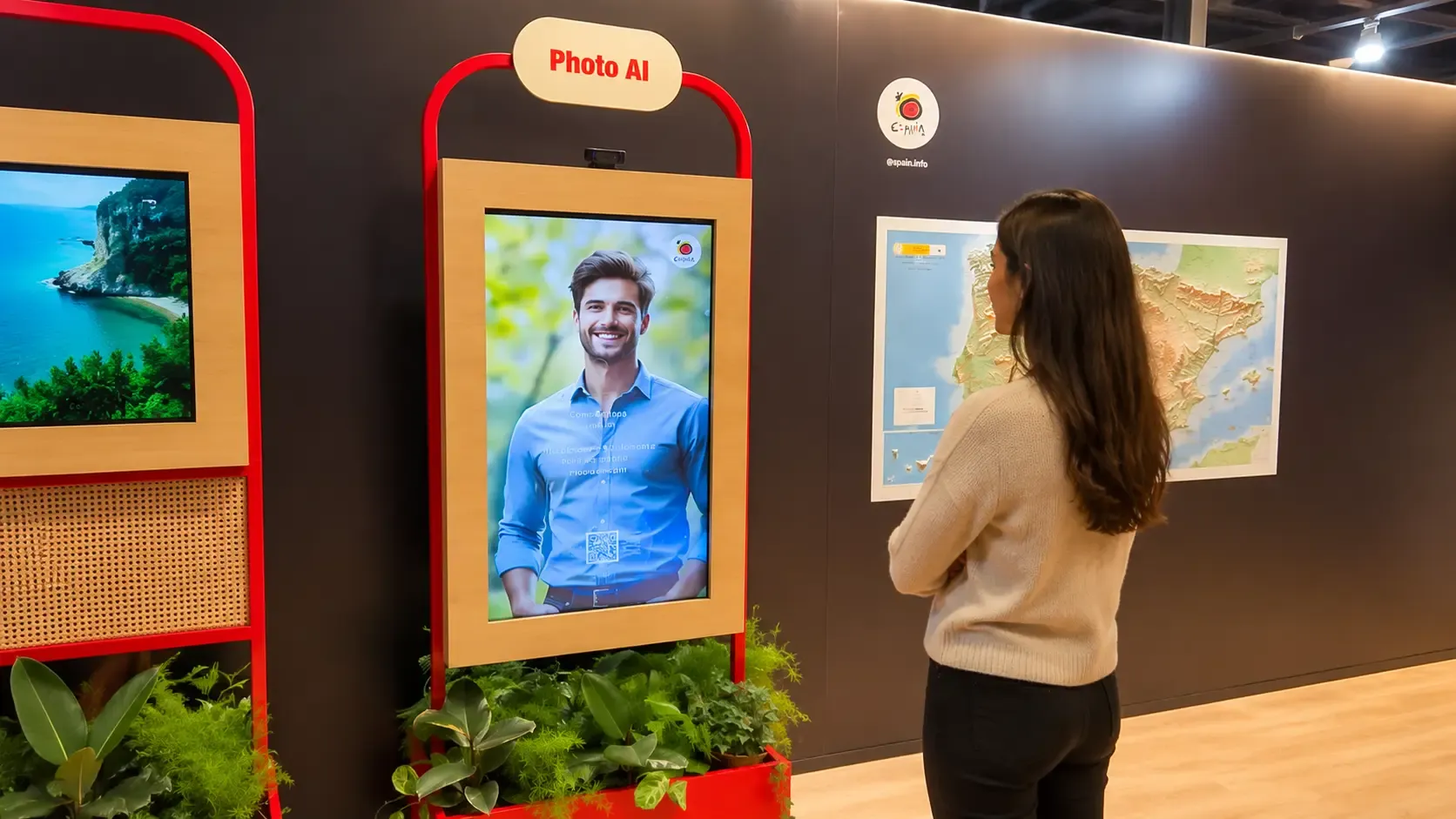
A realistic photo of a visitor in a real place, like those created by Photo AI for Turespaña when it takes visitors to places across Spain, falls in the zone worth treating as a deep fake. Nobody is misled on the stand, but the image is made to be shared. The prudent option is to label it in the file itself, not just on screen.
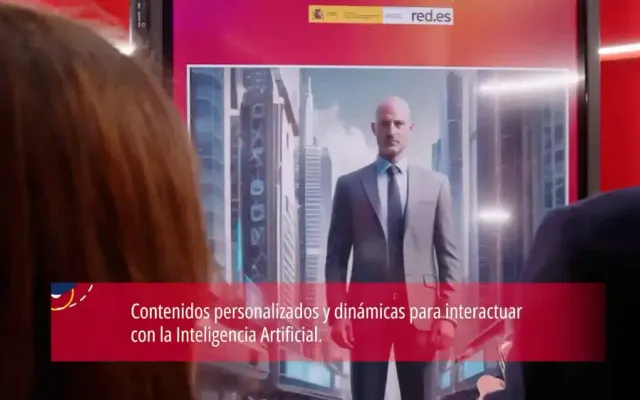
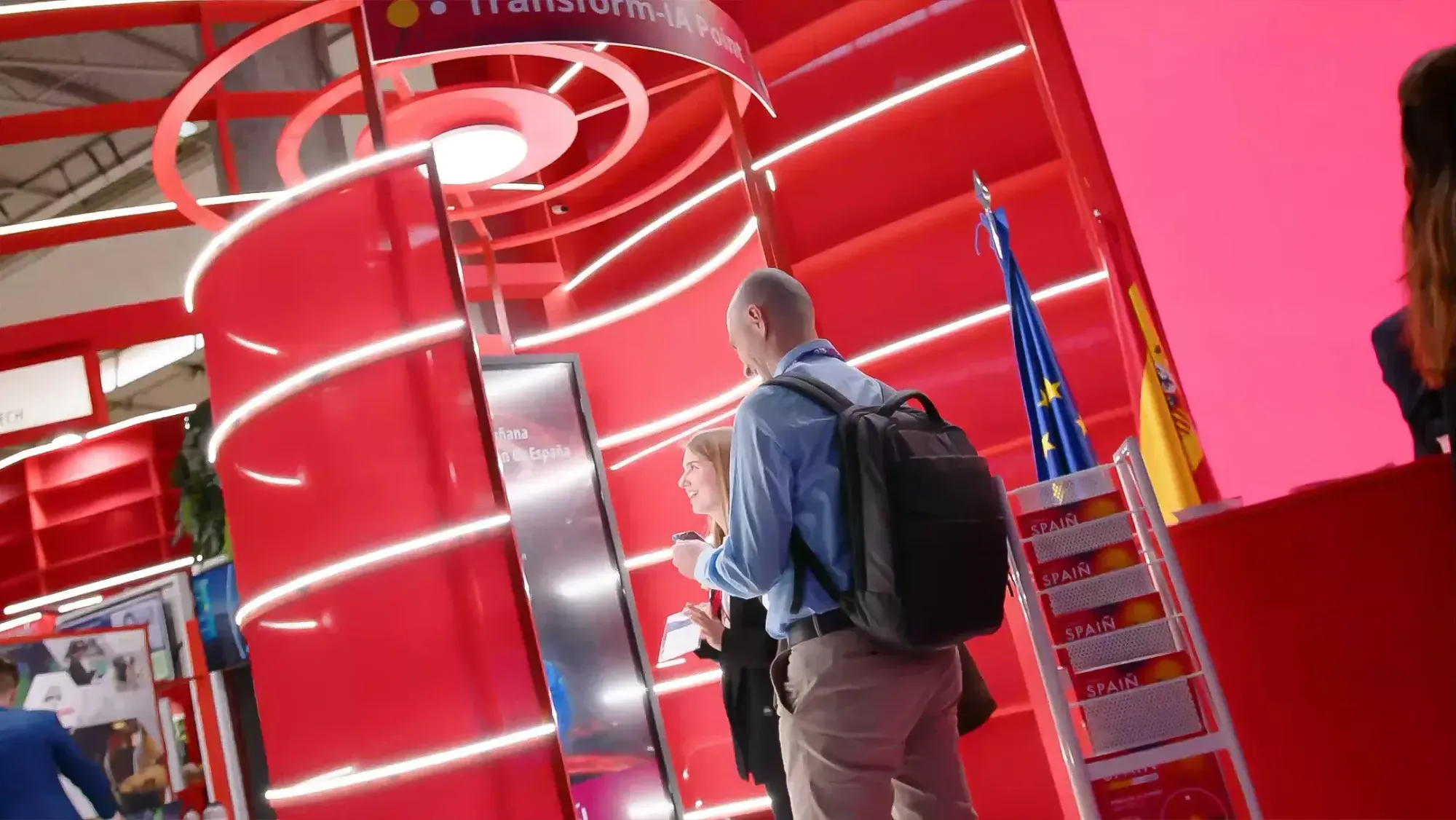
A clearly impossible scene reads differently. The guidelines exclude content that defies physics and cannot mislead. A futuristic setting like those in TransformIA for Red.es leans towards the evidently creative or unreal, although it depends on how realistic each scene is.
A creative register does not remove the notice, it lightens it: the disclosure can be built in without spoiling the work. That category is also read strictly. Purely commercial content does not qualify just by looking good. That is why we still recommend always labelling, as we argued when writing about gamified experiences. And a photo of a face remains personal data: consent, retention and deletion are a separate matter.
Executive avatars and product images
Brand content holds more surprises. Among its deep fake examples, the guidelines include a video of a realistic avatar of a CEO congratulating staff on the results. If a corporate congress plans something like that, the notice belongs at the start of the video. If people may walk in halfway through, repeat it.
They also mention an AI-generated product image that shows it as different from, or better than, the real thing. By contrast, a real product against a generated background is fine as long as it does not mislead about the product. The useful question is not "is there AI?" but "does this change what someone believes they will see or buy?".
Cameras that read the audience
A kiosk that estimates age or gender from faces to adapt its message is, in principle, biometric categorisation, and the people exposed to it must be told. The guidelines give the example of a notice at every entrance to an exhibition room.
Inferring emotions from biometric data is another league: those systems are classed as high-risk, with far heavier requirements, and they are banned in workplaces and education. For a brand activation, our rule is simple: if the data is not essential, do not capture it.
Checklist before the event
- List every AI touchpoint: assistants, avatars, images, videos and cameras.
- Assign roles: provider, deployer and who approves the notices.
- Classify each output: interaction, deep fake, evidently creative work or no apparent obligation.
- Design the notice as a screen, voice, icon or in-file label, in the audience's language and accessible. The Code of Practice offers an optional EU icon in three variants.
- Ask the provider to confirm machine-readable marking, especially for systems dating from before 2 August.
- Test it with outsiders: if they cannot recall the notice, it has not worked.
- Validate it with the brand's legal advisers, alongside data protection.
If you are planning an AI photo booth, kiosk or avatar, tell us about your event. At Viseni, we can help you design an experience where the notice builds trust instead of breaking the spell.