Blog
Real estate in 2030: how homes will be seen, decided on and sold
A realistic look ahead to 2030: a living model of each property that changes with every decision and site visit, AI assistants that answer from project data, and images that say what they are.
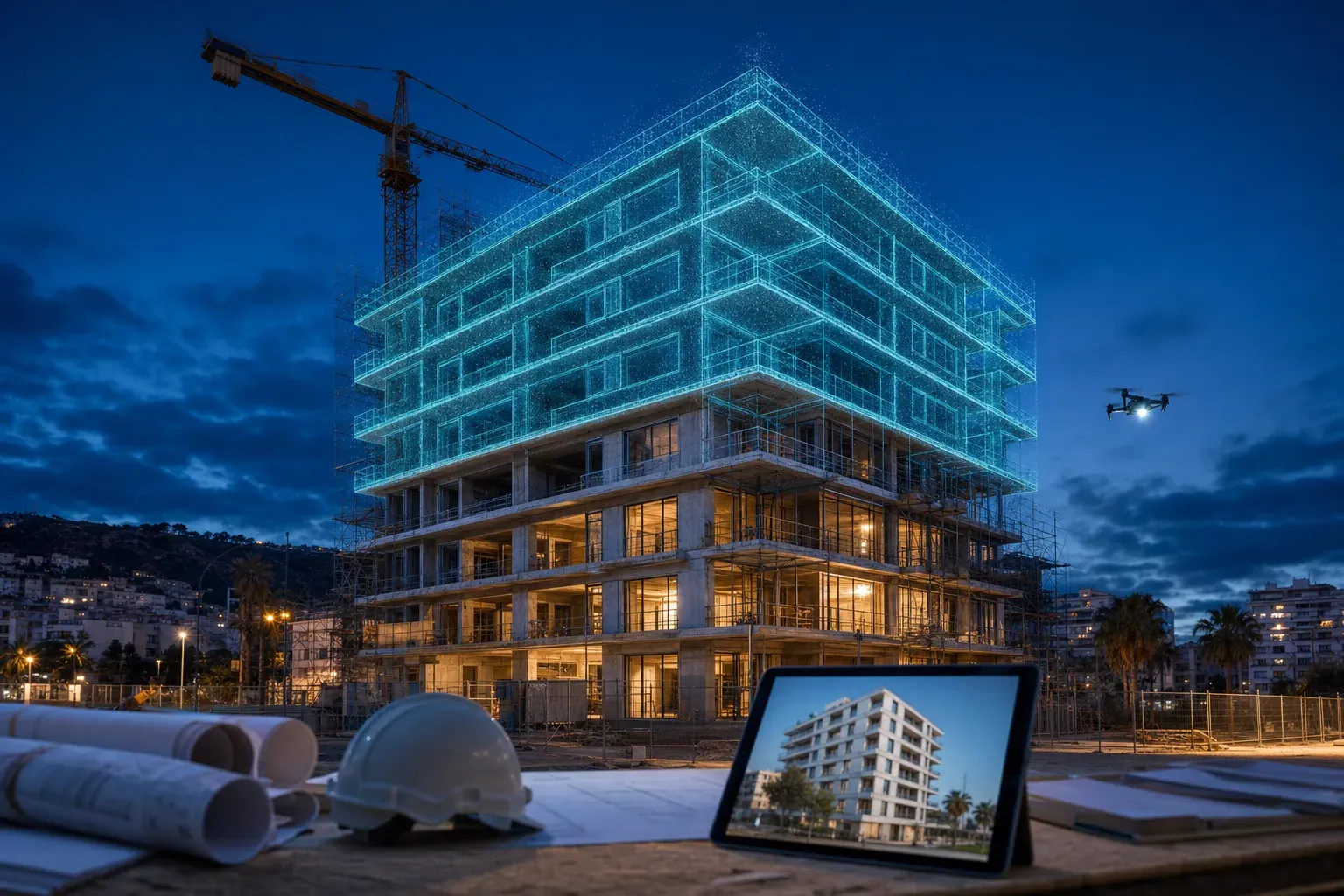
Picture an October evening in 2029. A buyer living in Munich opens the link to her development in Málaga. She does not see a brochure: she sees her own flat, third floor, door B, in the real light of that hour and with the flooring she approved yesterday. Next to each room sits Thursday's site capture, aligned with the model, and its status: partitions finished, services checked, joinery pending.
She asks whether a 2.40-metre kitchen island will fit. The assistant answers with the dimension from the current drawing, links to the document it comes from and, because the question implies a change to the design, passes it to the developer's technical team.
None of this requires inventions that do not already exist. The difference in 2030 will not be a new technology but a living model of each property: a single source of truth that changes with every decision and every site visit, and instantly produces images, video, walkthroughs and answers. This is a forecasting exercise: what is already under way in 2026, and what cannot yet be promised.
The pieces are already on the table
This forecast starts from facts established this year, not from promises:
- Reality capture has a standard format. The KHR_gaussian_splatting extension is listed as ratified by Khronos and, since 3 September 2026, appears in the official registry of glTF, the most widely used 3D exchange format. We explain what Gaussian Splatting is.
- AI already turns a photo into an editable scene. On 9 September 2026, Hyper3D launched WorldGen, which converts a single image into a 3D scene made of independent objects that can be moved and replaced; interior design is among the uses it lists. It publishes no accuracy data, so it is a tool for imagining, not measuring.
- Synthetic content now has rules. Since 2 August 2026, Article 50 of the EU AI Act has applied: people must know when they are talking to an AI, systems that generate images or video must mark their output as artificial, and anyone publishing a deepfake must say so.
- Buildings will carry a digital record. Directive (EU) 2024/1275 requires all new buildings to be zero-emission from 1 January 2030, requires their life-cycle carbon footprint to appear on the energy performance certificate, and defines the digital building logbook as a common repository of their data.
From commissioned renders to a living model of the property
Today, changing a floor finish in a development usually means reopening the commission: editing the scene, re-rendering the images, re-cutting the film and updating the brochure.
By 2030, the sensible approach is for the model itself to be the deliverable. Construction-stage geometry, materials with manufacturer references, furniture at true scale, the status of each room and energy data will live in one place. Images, film, 360° tours and virtual reality will be outputs of that model rather than separate commissions. Change the floor, and every output changes with it.
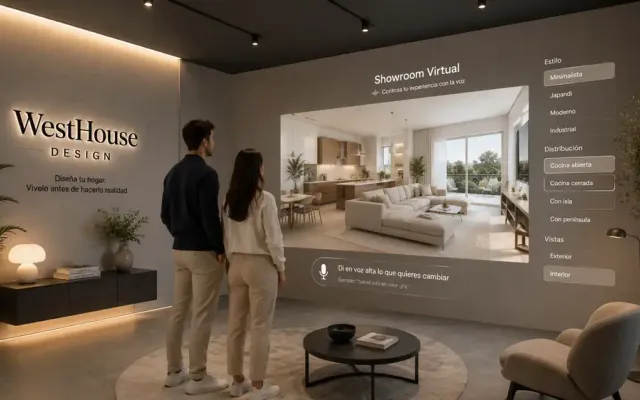
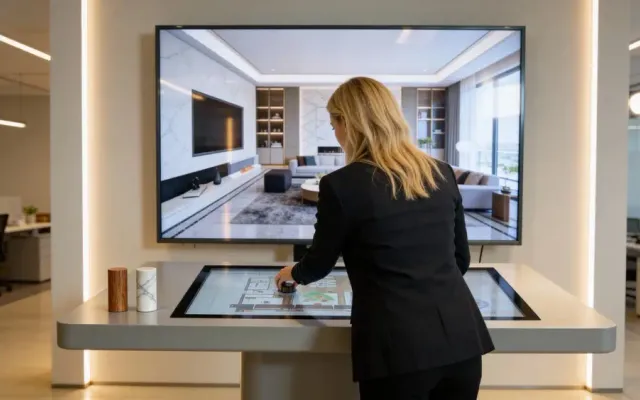
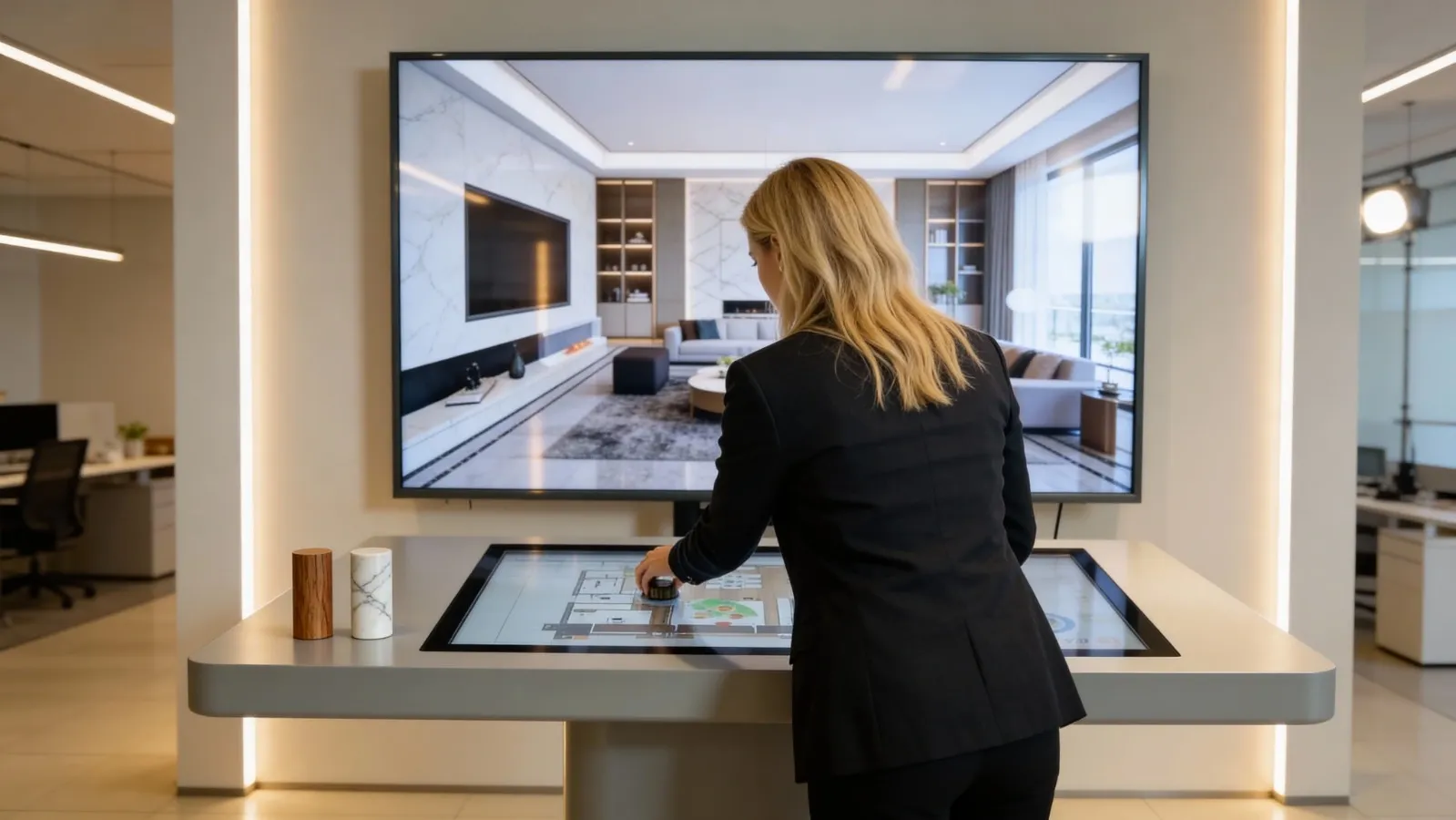
Real-time engines already make this possible in a sales suite. In VLI Commander, built in Unreal Engine 5 for a client's showroom, buyers move through the home on a touchscreen and choose flooring and finishes while a second screen shows the interior in photorealistic quality. The step towards 2030 is to take that experience out of the showroom, put it on every buyer's phone and connect it to the model the site team works from.
Every change on site or in a renovation, visible straight away
Site monitoring is where the biggest shift will happen. In the scenario we propose, every visit leaves a capture from fixed positions, using a phone, a 360° camera or a drone, which becomes a navigable model aligned with the design:
- The developer spots deviations before they become expensive: a socket box out of place or an opening at the wrong height shows up when capture and model are compared.
- The buyer or homeowner sees their actual home, not a generic photo of the build stage.
- Every approved change is recorded with its date, version and who made the decision.
In renovations the cycle will be even shorter: measure the existing space, propose options on that capture, and check what was built against what was approved. The same directive set 29 May 2026 as the deadline for member states to introduce renovation passports; a visual, measurable history of each intervention fits that logic of a building record.
Captures do not take themselves: someone has to visit the site, and accuracy depends on the equipment and the method. AI will flag differences, but deciding whether a deviation is a mistake or an agreed change will remain the job of the site management team. For owners following their home from abroad, we go into more detail in deciding every detail without being on site.
AI assistants that answer with the project in front of them
Most of a buyer's questions are answered in documents that already exist: specifications, floor plans, timelines, availability and reservation terms. By 2030 it will be normal for an assistant to answer them at any hour, in the language of whoever is asking.
The condition is that it answers with the project in front of it: citing the source document, saying "I don't know" when the information is missing, and handing over to a person anything involving negotiation, changes to the home or the interpretation of a contract. Buyers must also know they are talking to an AI, as European law already requires.
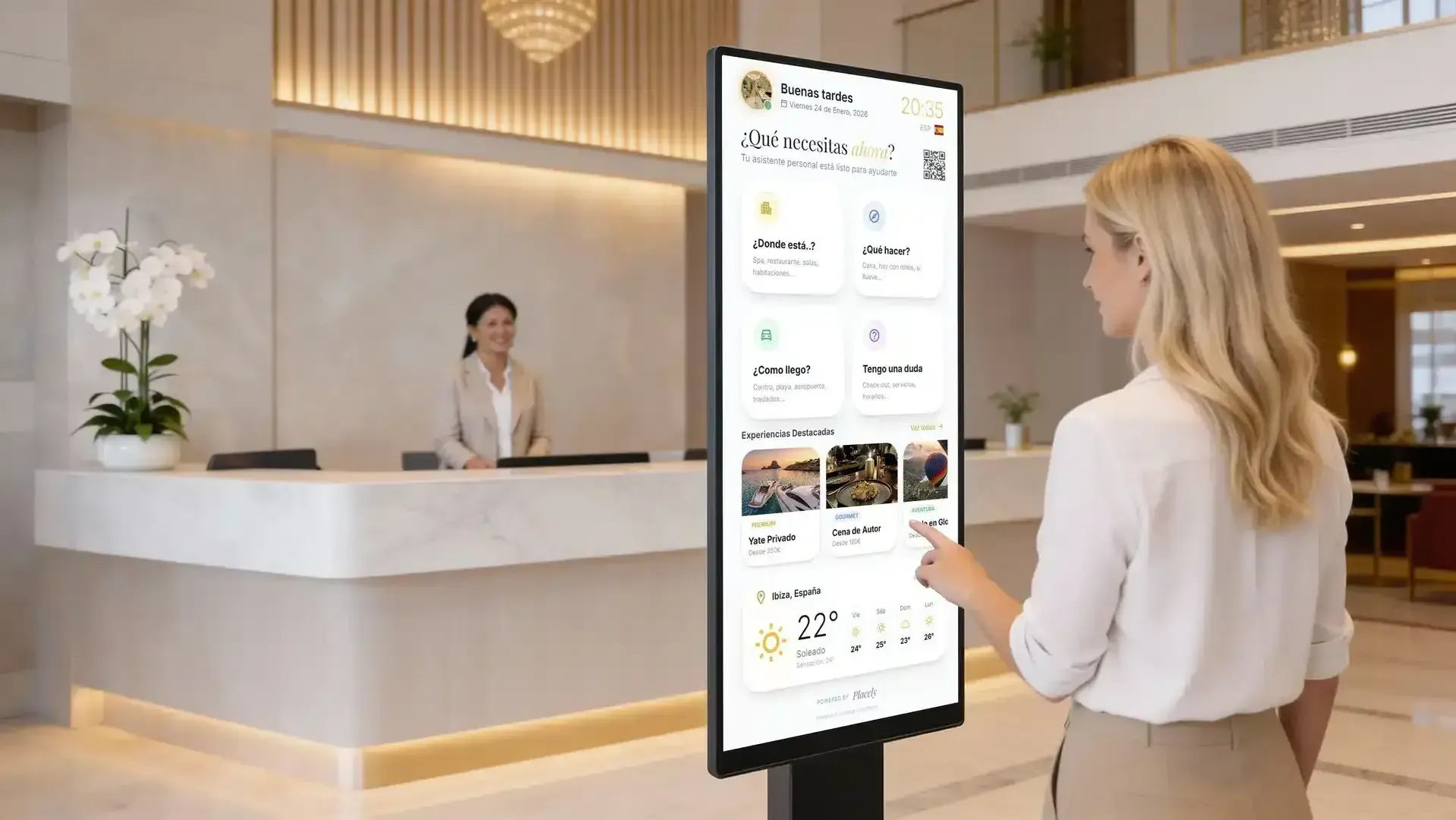
We have applied this in another sector. Placely is an AI-run digital point for hotels built on large language models: it answers guests' questions, recommends services, shows what is on in the city and runs unattended. The same pattern, fed with a development's documentation, becomes a sales office that never closes.
Generative images and video: faster, but required to say what they are
Generative AI will make variations cheap: the same terrace in winter and summer, the living room with different furniture, the arrival at the house at different times of day. The risk grows at the same rate: an image that sells something that will never be built. That is why we suggest separating two kinds of material:
- Design imagery comes from the measured model. It is for making decisions and signing contracts.
- Mood imagery may draw on generative AI. It is for inspiration and is labelled as such.
At Villa Soal, the aerial view explains how the villa sits on its plot: stepped platforms, terraced gardens and an infinity pool completing the composition. That is the kind of image that has to come from the design, because buyers use it to understand what they are buying.

What will not change, and how to prepare now
Some things 2030 will not solve. Physical viewings will still weigh on the final decision, trust will still be built by people, and any system will only be as good as the data behind it. An assistant working from out-of-date specifications simply gives the wrong answer faster.
What you can start doing now:
- Work from a single model from the design stage onwards, and produce every sales asset from it.
- Name each material by its real product reference, not a generic texture.
- Organise the development's documentation so that an AI can cite it.
- Distinguish and label AI-generated content from the very first campaign.
- Treat the buyer's website or app as a living record, not a brochure.
If you are preparing a development, a build or a renovation and want your client to see every change as it happens, tell us about the project. We start with the model and build the images, film, website and app from there.