Gaussian Splatting: from a real place to a navigable 3D experience
A different way to digitise existing places: what Gaussian Splatting offers, where other models are needed, and how to evaluate it through a focused pilot.
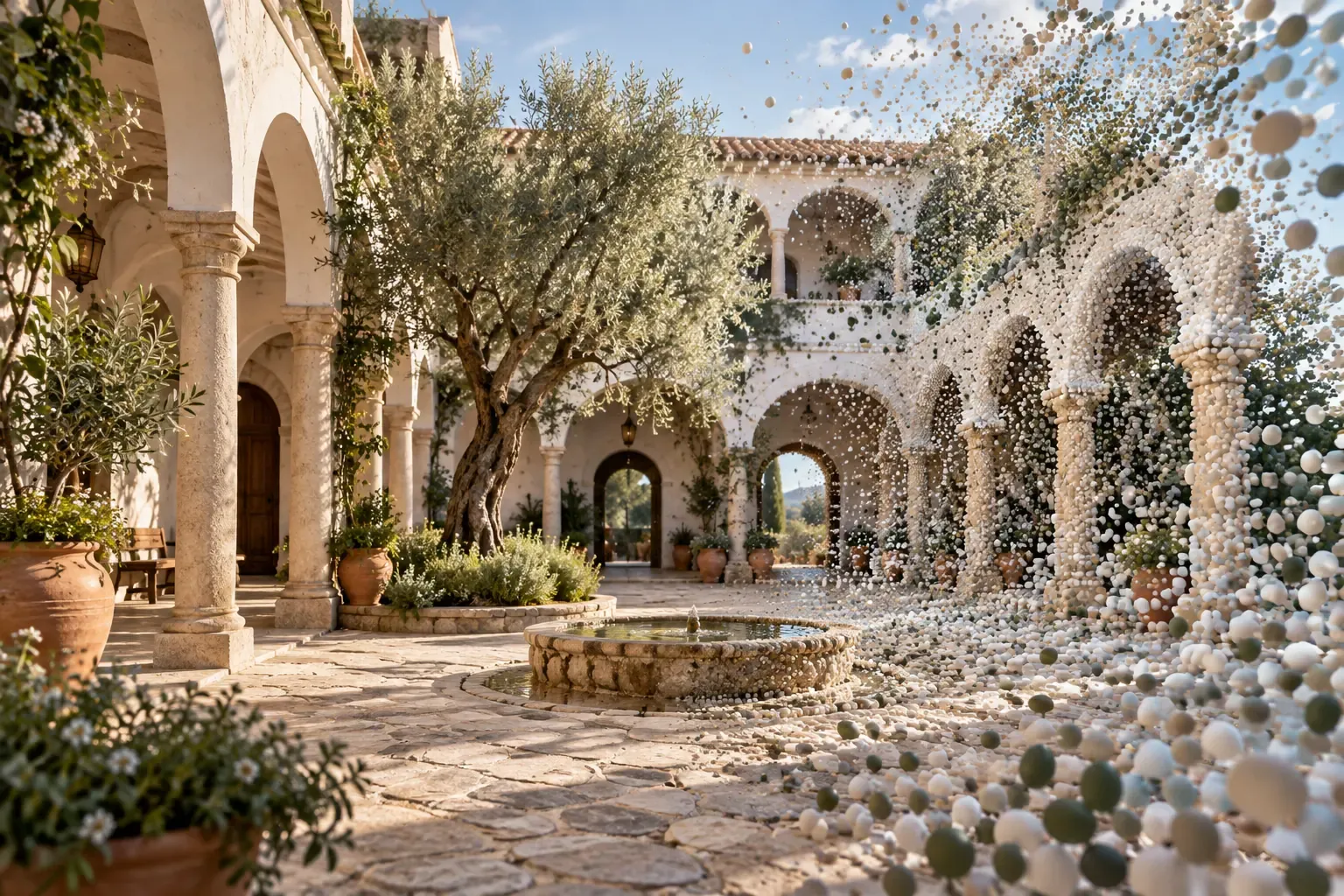
A historic courtyard carries its story in small irregularities: worn stone, olive leaves and variations in the plaster. Recreating it piece by piece means deciding which details deserve to be modelled. Gaussian Splatting offers another starting point: capture the place and reconstruct its appearance so people can explore it from different positions.
For a hotel, museum or event venue, the opportunity is specific. Someone viewing remotely can understand how spaces connect and notice details that a selection of photographs leaves out. The work begins by deciding what that person needs to understand.
What a captured space actually contains
3D Gaussian Splatting represents a scene using small volumes with position, shape, colour and opacity. Optimised from images, they combine to produce new views. The original research by Inria and its collaborators introduced this representation and an interactive rendering approach.
The result can retain a photographic appearance. That does not automatically make it a technical drawing or a model in which every object is ready for modification. Establish early what information the experience must provide and which decisions it cannot support on its own.
How it differs from a mesh and photogrammetry
A mesh describes surfaces using vertices and polygons. It provides an explicit structure for assigning materials to parts and modifying them. Splats describe the appearance of a space through volumetric contributions; the result does not necessarily contain separate, editable walls, doors and furniture.
Photogrammetry can contribute to both workflows: images help estimate camera positions and structure. The meaningful difference for a client is the deliverable. Do they need to explore a place visually, change its layout or obtain verified geometry? Those are different commissions even when they start with a camera.
A museum, for example, might prioritise movement between rooms and the context around exhibits. A manufacturer that needs to position components accurately will need geometry prepared for that purpose. Choosing the format after defining the task avoids discovering these distinctions during integration.
Plan the capture around the visitor's route
Source photographs need varied viewpoints, sufficient overlap, sharp detail, consistent exposure and continuity between areas. Moving people, windblown foliage and reflective surfaces can introduce artefacts. The PlayCanvas capture guide explains these factors.
For a pilot, we would first draw the route a visitor should follow. In the courtyard example, that might mean entering beneath an arch, crossing towards the fountain and looking back at the doorway into the building. That sequence becomes a practical reference for reviewing the capture.
It is also useful to agree what will remain outside the route. A closed door matters if the commercial objective is to explain the connection to another room. Preparing the location should support the visitor's journey as well as the camera requirements.
Three limits that change the project scope
Measurement. A convincing visual reconstruction does not certify dimensional accuracy. Checking an entrance width or deciding whether an installation will fit requires suitable scale references and validation against the required tolerance. Displayed measurements should come from a verified source and be identified accordingly.
Editing. Removing an area visually is different from obtaining a clean object that can be repositioned. It also does not reveal the surface previously hidden behind it. To compare two furniture layouts, preparing dedicated geometry for that zone may be more practical, while keeping the capture as context.
Lighting. A capture retains the lighting present at the time. Changing it takes additional work. Techniques such as PlayCanvas relighting through a proxy mesh exist, but their quality depends on how well the mesh fits. A day/night selector needs validation on the actual scene, particularly when strong shadows or reflections are involved.
These constraints inform the budget. If decisions depend on measurements, material changes or several configurations, those requirements belong in the brief before a capture method is selected.
A hybrid application can make the capture more useful
Imagine a venue that wants to present three arrangements for a company presentation. The capture could preserve the building's character, while the stage, chairs and signage are built as independent models. Capacity details and access information would belong to the application.
That separation makes it possible to update information without rebuilding the entire experience. It also helps distinguish the documented space from a proposed arrangement. A venue manager should be able to tell what they are looking at and which version it represents.
The focus then moves towards designing interactive 3D experiences: understandable controls, useful points of interest and navigation that lets people return to the start. Visual fidelity creates interest; the interface must help visitors answer their questions.
Design a pilot that answers a useful question
Before capturing an entire building, we would propose agreeing on five things:
- One specific question: for example, understanding the route between reception and the main room.
- A contained area: enough to answer that question and inspect its difficult points.
- A target device: the phone or laptop the intended audience will use.
- Observable criteria: completing the route, locating entrances and loading the experience under representative conditions.
- A maintainable handover: source files, capture version, update responsibilities and an alternative with images and text.
We would also test the link over a mobile connection with people who have not been involved in the project. If they need constant instructions or cannot find the intended information, the next effort should focus on usability.
Do your customers need to understand a place remotely? Tell us what they need to learn or decide, and we can define a capture and visualisation scope to evaluate together.