
3D video for public tenders: the specifications, explained in motion
A strong 3D film does more than impress: it follows the tender criteria, flags every technical detail with titles and voice-over, and frees the team to defend the proposal.
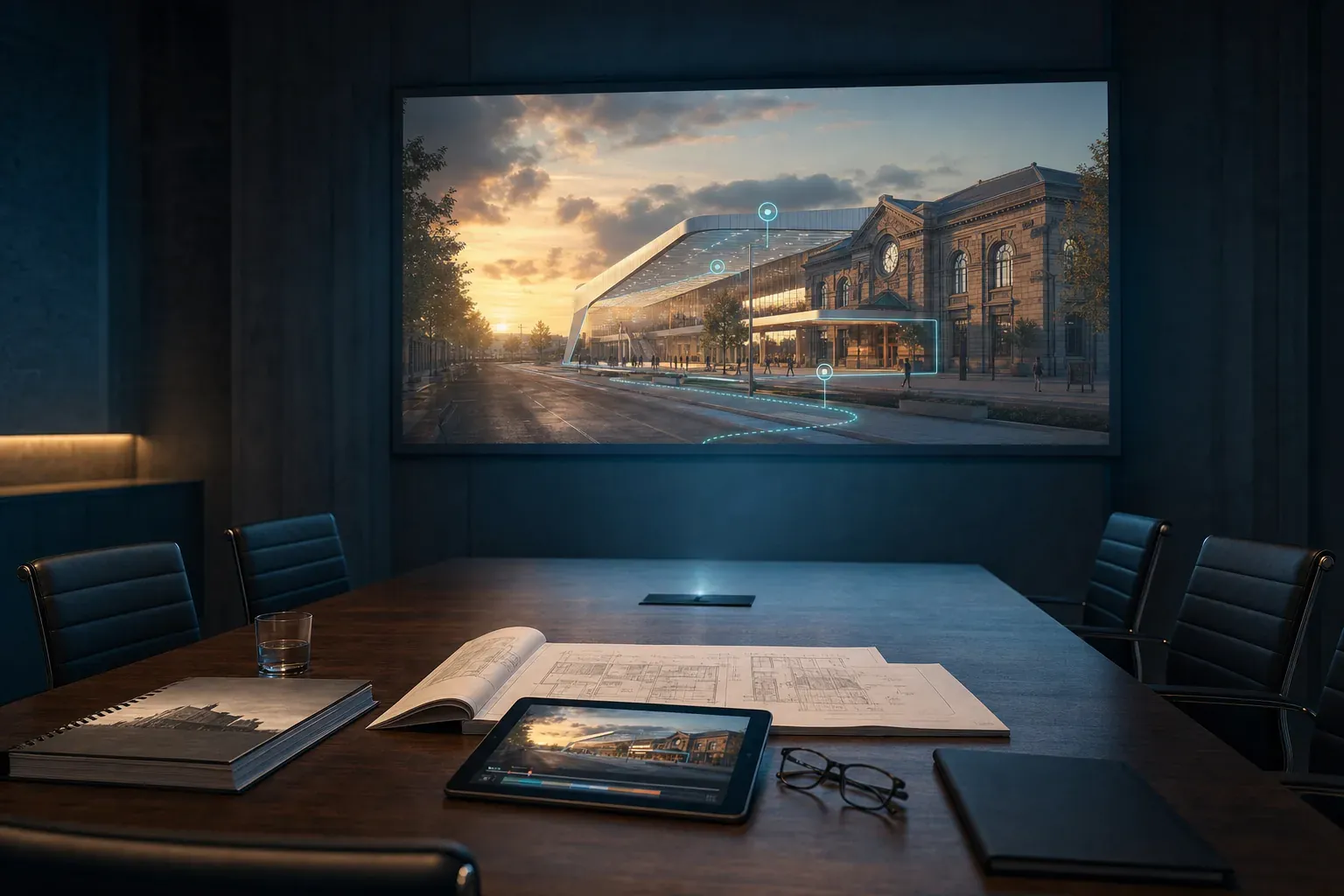
Ten minutes to defend a proposal in front of a panel that has already seen dozens. The team jumps between the technical report, the drawings and a folder of renders while running through every point of the specifications in their heads. Each time they look for the right image, the room loses the thread.
The problem is not the quality of the project. It is that nobody has organised how the story is told.
In a public tender, 3D video is not decoration: it is the clearest way to prove, in the order the specifications set, that the proposal answers every criterion. In an earlier article we covered which visual material tends to score; here we focus on video and on what it achieves that a still image cannot.
Who watches the film, and against which criteria
Spain's Public Sector Contracts Act allows qualitative award criteria to cover quality, including technical merit, aesthetic and functional characteristics, and accessibility. Many of these depend on expert judgement. In open or restricted procedures run by public authorities, when those criteria carry more weight than the ones scored automatically, they are assessed by a committee of at least three experts or by a specialised technical body.
That is the real audience: technical evaluators comparing proposals with the specifications open beside them. They are not looking for an advert. They want to find, quickly, where and how each bid answers what was asked.
So a tender film is designed the opposite way to a marketing film. First, list what will be assessed; then decide which shot proves it best.
What a film explains that a render cannot
A render freezes one moment from one viewpoint. A film links moments together, which makes it possible to show processes that a still image can only hint at:
- Routes: the accessible path from the street to the platform, the hall or the counter.
- Flows: people, vehicles or goods moving without crossing where they should not.
- Phases: how construction progresses while the building stays in service.
- Systems: an animated exploded view of the façade, the roof or the building services.
- Context: before and after in a protected setting, from the same camera position.
For the Food & Goods proposal at ADIF's Toledo station, the still images were joined by a 3D video render to explain the proposal to the evaluation panel. The terrace, furniture and signage had to read alongside the station's Neo-Mudéjar façade, within a protected setting.

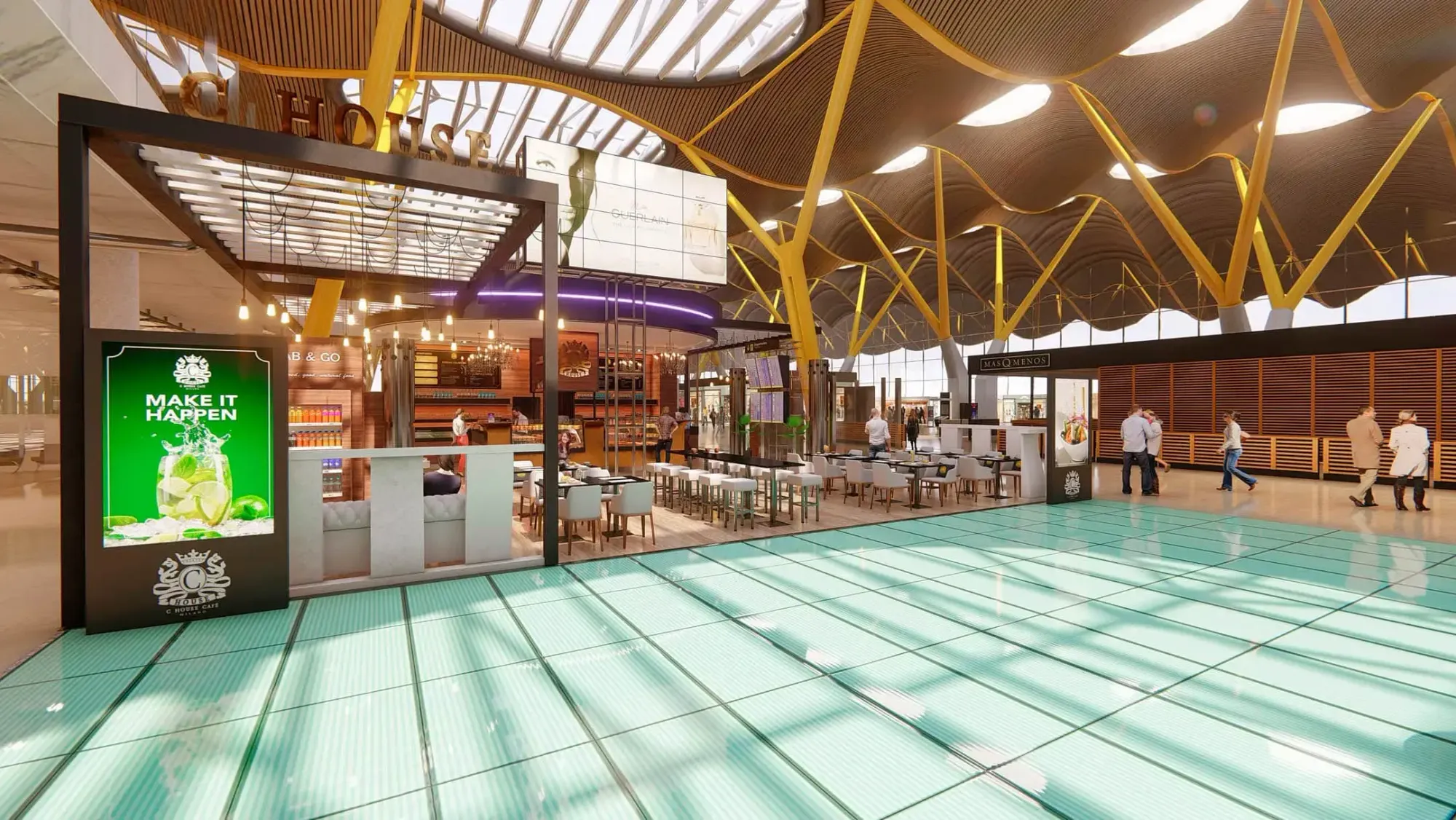
Concession tenders work in a similar way. In the units we have visualised in terminals and stations, including Terminal T4, the panel assesses each proposal inside the existing building, with passengers flowing around it. In a still image that flow is implied; in a film, people walk past, stop and show whether the space actually works.
Titles and motion graphics: the specifications, flagged on screen
Graphic titles turn the film into a document the panel can consult. A short caption names the criterion being answered; an arrow traces the route; a dimension line pins down the measurement that matters; a highlight isolates one element while the rest of the scene dims.
There is a reason to do this with restraint. Richard E. Mayer's cognitive theory of multimedia learning starts from the idea that we process verbal and visual information through separate channels, and that each channel can only handle a few pieces of information at a time. One of its principles recommends removing unneeded material.
Applied to a tender, we suggest three rules:
- One idea per shot. If a shot answers two criteria, split it.
- Short captions. Long text belongs in the technical report, not on screen.
- Nothing decorative competing for attention. A beautiful shot that answers no criterion takes time away from the ones that do.
Professional voice-over: a script that supports the presenter
A professionally recorded, bespoke voice-over guides the panel's eye: it announces what is coming, explains it as it happens and closes each section before moving on. Words arrive through the ears and images through the eyes, so the two channels share the load.
The presenter no longer has to remember every point in order. The film holds the structure, and the team can focus on what only people do well: adding nuance, answering questions and conveying conviction.
Voice-over also protects the message when nobody is in the room to defend it. If the film is part of the submitted documentation, the panel can watch it again during the assessment and will hear exactly the same explanation.
It is worth planning several versions:
- With voice-over and subtitles, for submission and for rooms where the sound fails.
- With titles and no voice, for an oral defence in which the team speaks.
- In chapters, with pauses between sections. Mayer describes breaking a continuous video into segments as a way of managing the effort of understanding; in a live presentation it also lets you stop to answer a question and resume without losing the thread.
What the specifications never forgive: format and anonymity
The law requires bids to comply with the tender documents, and the film is no exception: duration, format, resolution, delivery channel and the envelope it belongs in. If the specifications do not provide for video, or restrict it, respect that. Excellent material outside the rules may never be assessed.
In design contests, the jury decides on anonymous proposals, and the law specifies that they must not contain data or clues of any kind that reveal the author. In a film, that covers logos, end credits, watermarks, file names and metadata.
When criteria based on judgement sit alongside criteria scored by formula, the law requires the judgement-based ones to be assessed first. A film that accompanies the technical bid should not reveal anything scored by formula, such as the price. Check this with whoever is preparing the bid.
Animation, motion graphics, live action and AI
At Viseni we have spent years producing every kind of film: bespoke animation, motion graphics and real people integrated into 3D scenes. We now bring AI into parts of the process, and in many cases it lets us raise the quality and reach more refined, efficient results.
AI can help preview a script before production or explore variations in light and atmosphere. What it does not do is decide the project: every shot must match the drawings and the report that are submitted. If synthetic voices or characters appear, agree how this will be disclosed, as we explained when writing about transparency for AI-generated content.
For a tender, we suggest this order of work:
- Read the specifications and extract the criteria, weightings and format requirements.
- Build a matrix that assigns one or more shots to each criterion.
- Write the script and voice-over with the same terms and figures as the report.
- Cut an animatic, a quick draft, to check order and duration.
- Produce the 3D animation, the titles and, where it adds value, live-action footage.
- Review technical consistency, anonymity and versions before submission.
If you are preparing a tender where video could make the difference, tell us what the specifications ask for. At Viseni we will propose a script that answers criterion by criterion and a film with the quality your project deserves.