Blog
Real estate technology: each housing segment needs different tools
The technology a home needs does not grow with its price. What 3D, video, virtual tours, VR and apps add depending on the market segment and on who is selling.
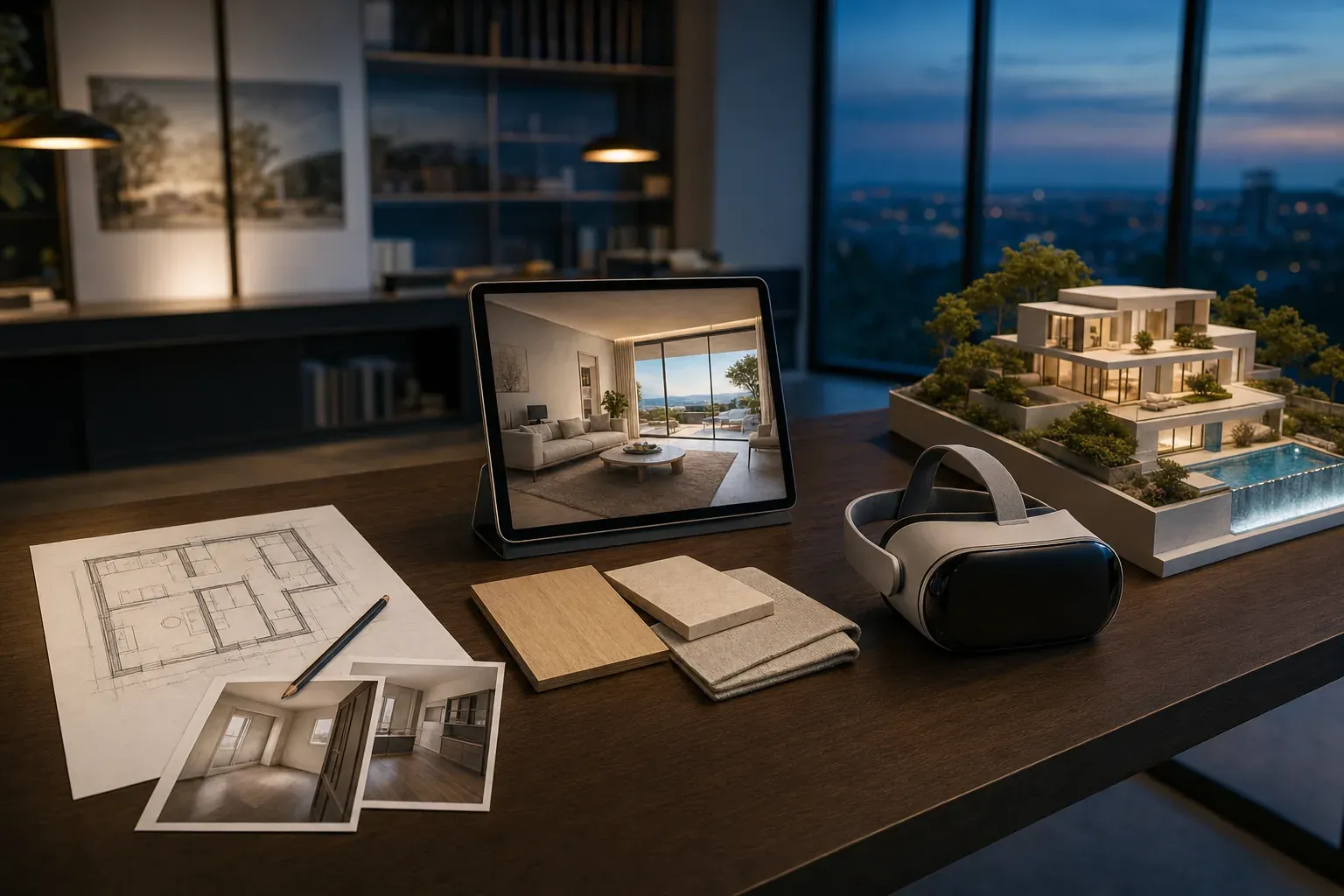
Three briefs that have nothing in common can land in the same week. A flat that sells with two photographs and a floor plan drawn on paper. A development of homes priced above one million euros whose buyers live in another country. And a villa worth several million whose renders are refined for months because the design keeps changing.
After all these years working with developers, architecture practices and estate agents, one conclusion keeps coming back: the technology a home needs does not rise in a straight line with its price. It depends on the market segment, on who is selling and on how settled the design is, and choosing the right tool matters more than choosing the most advanced one.
Entry-level and mid-market: when demand does the selling
Today this market is shaped by excess demand and very high prices. According to Spain's House Price Index from INE, published on 7 September 2026, housing prices rose 12.2% year on year in the second quarter of 2026, and resale homes 12.9%.
Under that pressure, many homes quite literally sell with two photographs and a floor plan drawn on paper: the buyer is already there and there is no commercial need to invest in advanced visualisation. It is the hardest segment in which to introduce additional technology, however affordable. What makes sense is little and honest: a clear floor plan to scale, photographs that show the home as it is and, for new builds, a few 3D views that explain the layout.
From one million euros: realism comes first
Above one million euros, presentation, architectural customisation, finishes and materials carry far more weight. Many clients prefer fairly conventional 3D, but with a carefully crafted level of detail and realism. The effort goes into design, materials and interiors, while investment in interactive technology tends to be more modest.
The opportunity lies with overseas buyers. On 19 November 2026, CaixaBank Research reported that home purchases by non-resident foreigners stand at around 47,000 transactions in the twelve months to the second quarter of 2026, their lowest level since 2021 yet clearly above the 2010–2019 average. According to the same analysis, they account for 32.2% of sales in Alicante, 26.6% in Málaga and 21.8% in the Balearic Islands.
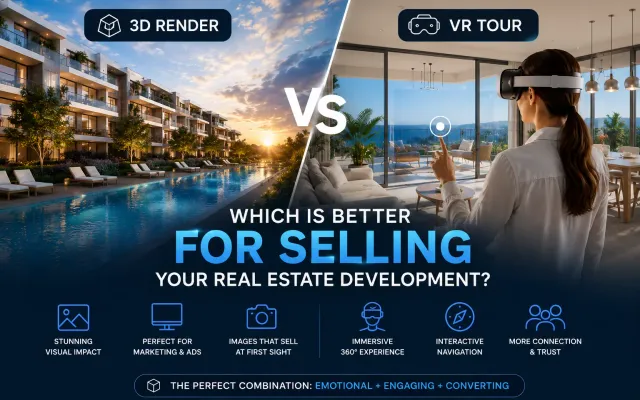
Buyers deciding from abroad need to get to know a home remotely, and that is where 3D video, interactive walkthroughs and virtual tours fit. With one condition: the realism has to match the product. We covered when a render or a tour works best in 3D render or VR tour.
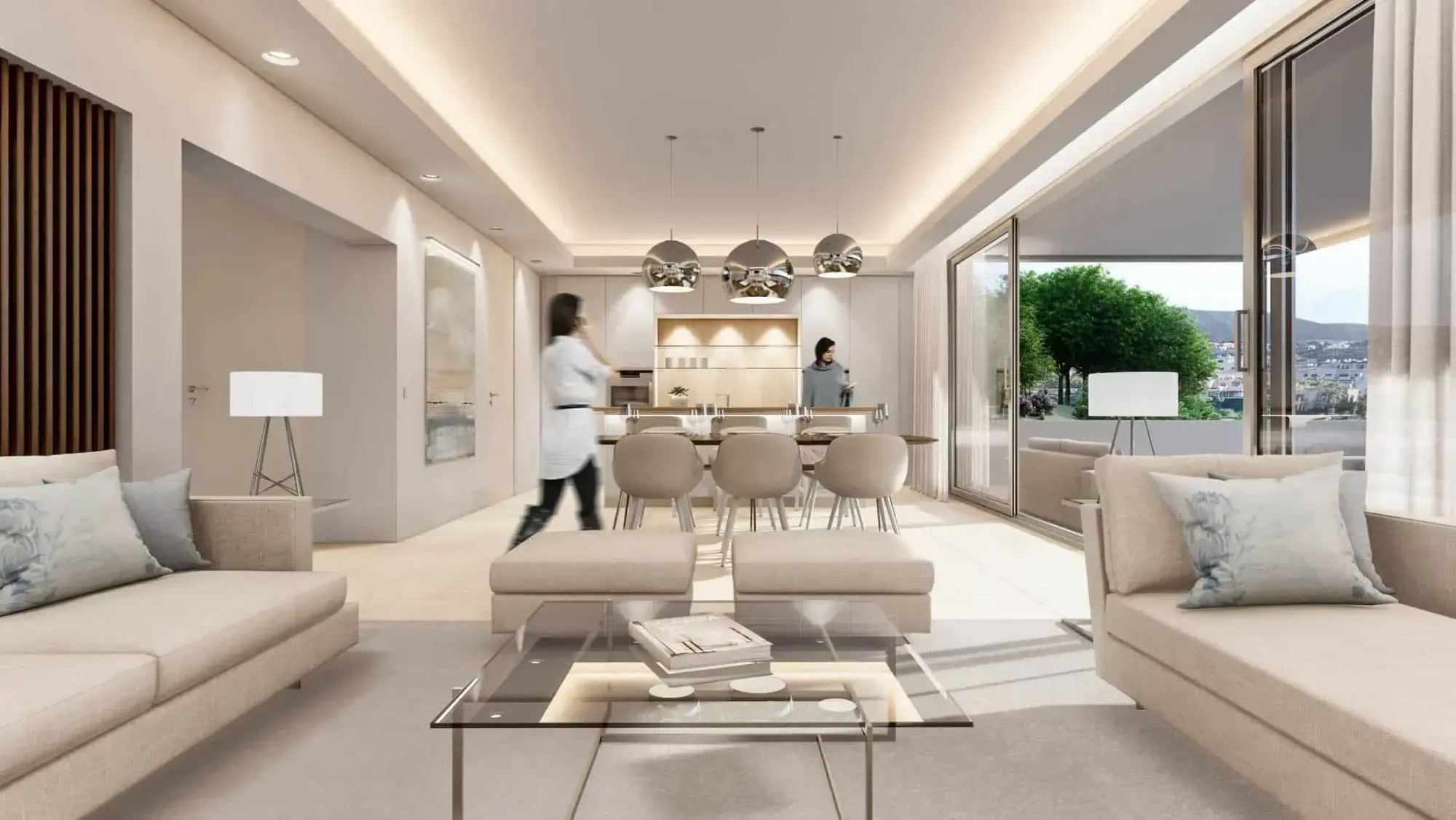
At La Resina, a residential scheme beside a golf course, the living and dining room completes the presentation with the typical interior of the homes: light, materials and furniture handled with the same care as the architecture.
Luxury, from five to ten million and beyond: another world
Here specifications, finishes, materials, lighting and every architectural detail must be represented with exquisite definition. The paradox is that these are the projects with the biggest budgets and, in theory, the greatest capacity for innovative technology, yet in practice they are usually the hardest to manage. Clients are extremely demanding, design changes can arrive every week and review rounds drag on. At times we spend months perfecting very high-quality renders while small details of the house are still being modified.
Developers and agencies show a lot of interest at first in an interactive virtual tour, but as the project moves forward, the priority almost always becomes visual fidelity and a realistic depiction of every finish. A complex interactive experience, with the architecture still in motion, would have to be rebuilt again and again.
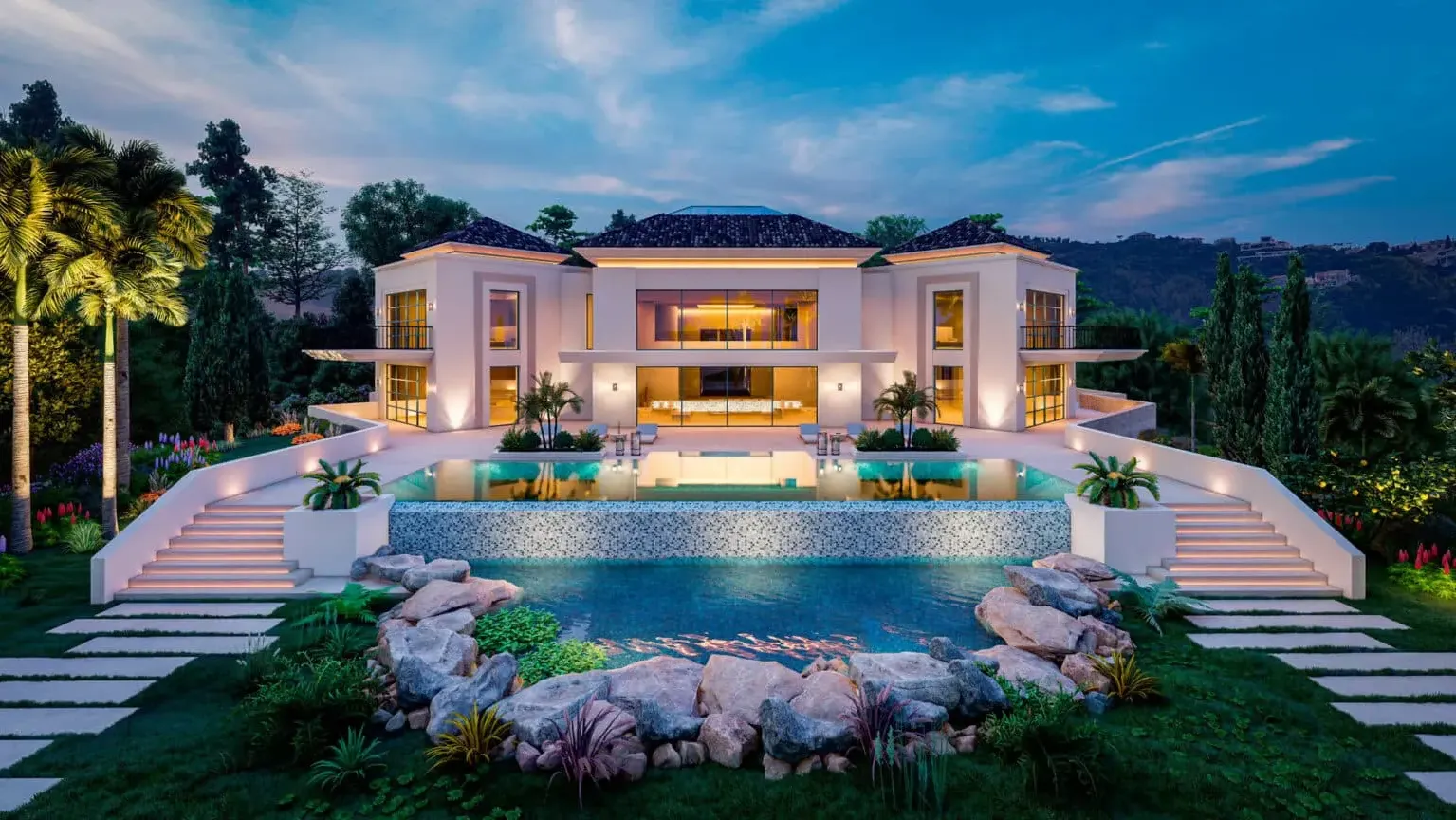
For the villa in La Zagaleta, the garden view is repeated at dusk with the exterior lighting on: light, planting and scale work together to convey privacy and the relationship between the house and its plot. We explain how every detail can be decided without being on site in luxury real estate on the Costa del Sol.
Who commissions what: developers, practices and agencies
- New-build developers. They have a budget for sales tools and a sales calendar that starts before the home exists. They get the most out of a sales suite, a finishes configurator or a sales app.
- Architecture practices. They need images that explain the project, to their client or in a competition. Many have in-house resources or regular collaborators, so an external service has to bring what they do not cover: real time, virtual reality or custom development.
- General estate agencies. Not all of them work the same way, of course, but in many, immediate profitability and speed of sale come before technological innovation.
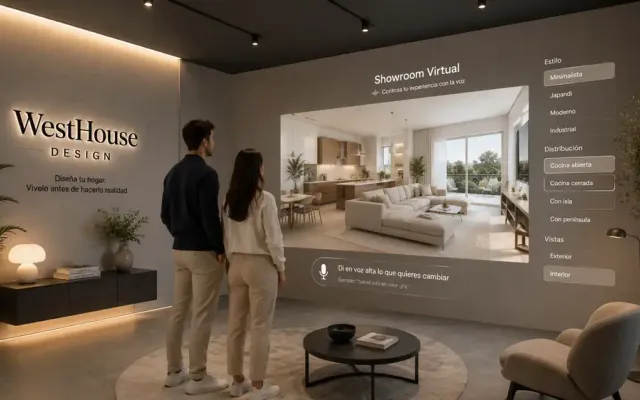
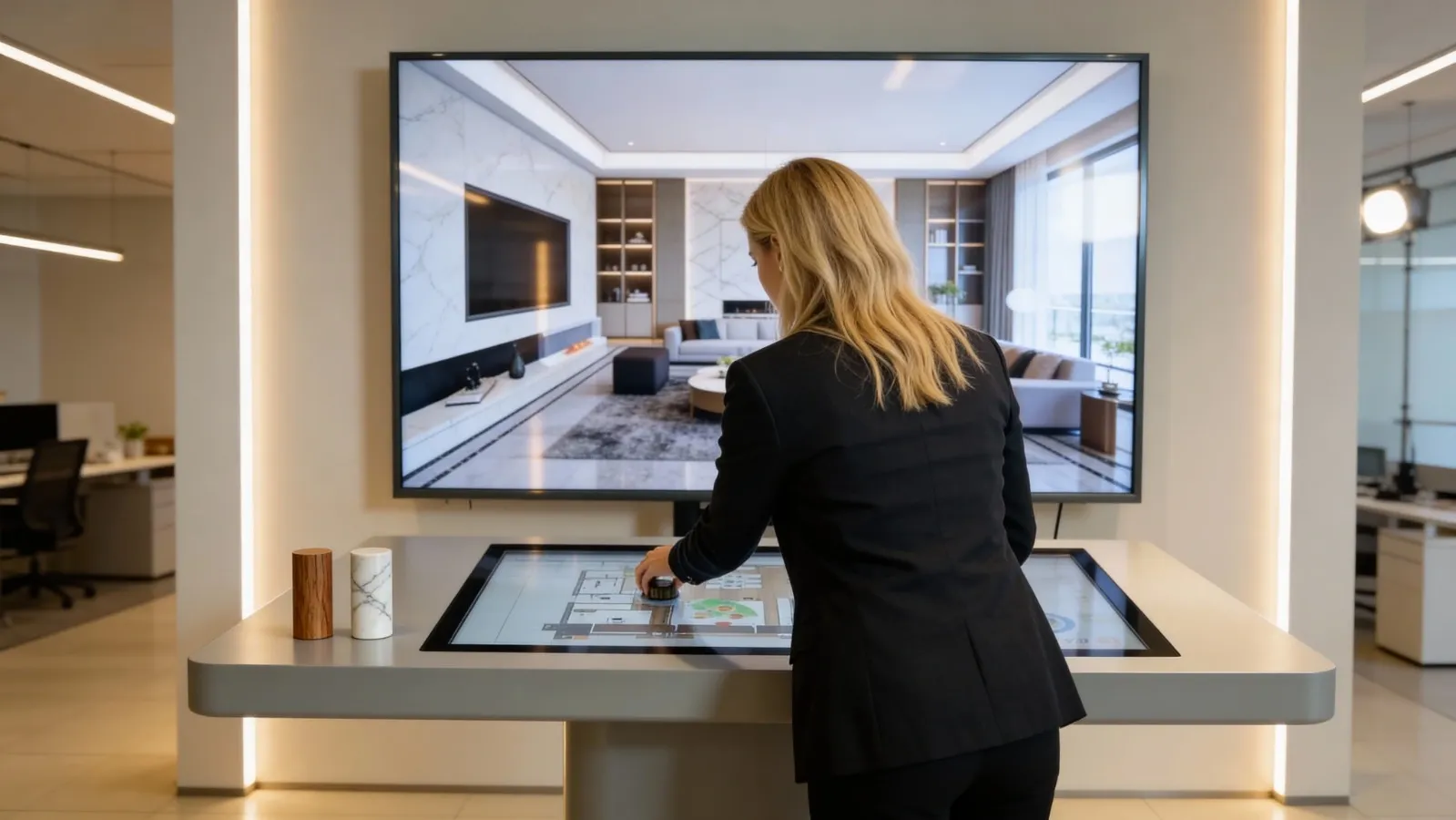
For developers, VLI Commander is an example of a point-of-sale tool: built in Unreal Engine 5 for a client's sales suite, it brings the visit together on two screens, with a photorealistic interior on a 60" display and a 32" touchscreen to move through the home and choose flooring and finishes.
When AI invents architecture
Some agencies now handle much of their imagery with a few photographs and generative AI tools that give the property a quick restyle. Sometimes these alter or invent architectural features that do not exist. Personally, I find that problematic, but it shows how far some operators prioritise selling fast and at the lowest cost.
It is not an isolated case. On 25 September 2026, Euronews reported that AI-retouched property images are spreading across Europe, and quoted the European consumer organisation BEUC calling for such content to carry a clear notice. Since 2 August 2026, Article 50 of the EU AI Act has applied: anyone publishing an AI-generated or manipulated image that resembles real places and could pass as authentic must disclose it.
Persuading that kind of client to invest in an elaborate virtual experience is difficult, and not always needed: what matters is that what is shown is true.
Where each tool fits
The split we find most reasonable:
- Floor plan and honest photography: the baseline for every segment and, in the mid-market, almost always enough.
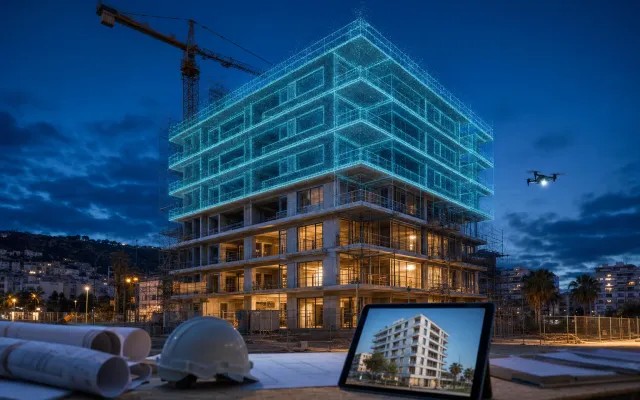
- Photorealistic 3D render: the core of off-plan sales and of homes above one million; realism is the condition.
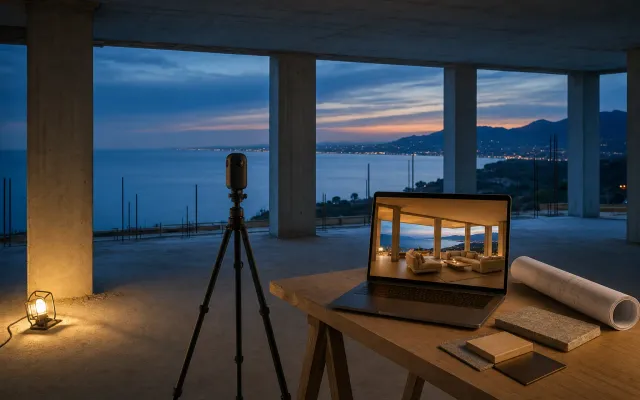
- 3D video: for buyers deciding from afar; it tells the arrival, the light and the setting in a minute.
- Virtual tour and interactive walkthrough: once the design is final, on a phone and with nothing to install.
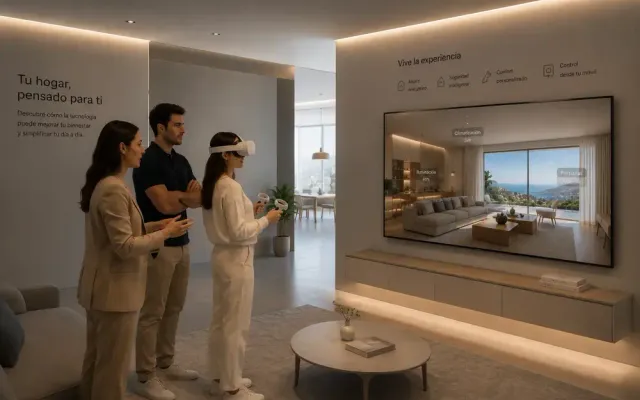
- Virtual and augmented reality: in sales suites, at fairs and in presentations; VR to be inside, AR to place the building on the table or the plot.
- Custom app or configurator: for developments with several home types, finishes to choose from and a sales team showing them every day.
Interactive experiences fit best in upper-mid-market new builds: there is a sales budget, the designs are reasonably settled and the client can allow several weeks of development without constant changes. There, a service with a fixed scope, predictable timelines and an experience that works on a phone makes a lot of sense. And the same rule applies everywhere: the level of realism has to match what is being sold.
If you are marketing a development, presenting a project or selling homes and are not sure which tool makes sense, tell us about the project. We will tell you what fits your segment, and what you do not need.