Blog
Interactive apps for trade fairs and congresses: from nice-to-have to brand investment
Attendees no longer want to watch: they want to take part. How an interactive app livens up an event, draws people in and builds authority, and why AI has made it more viable and secure.
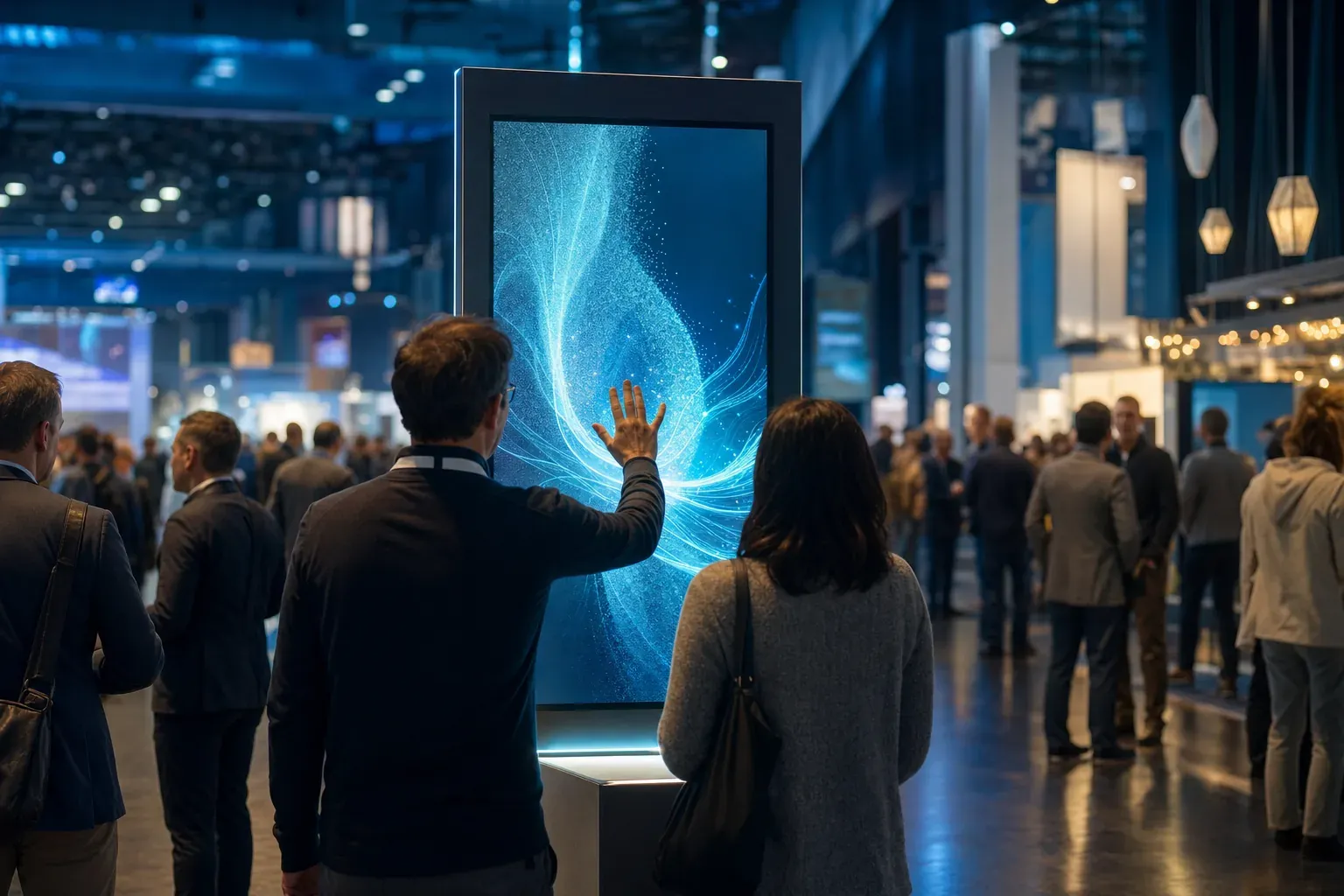
Day two of the congress. Between sessions, hundreds of delegates wander through the exhibition area, coffee in hand. They walk past brochures, looping videos and free pens. Hardly anyone stops.
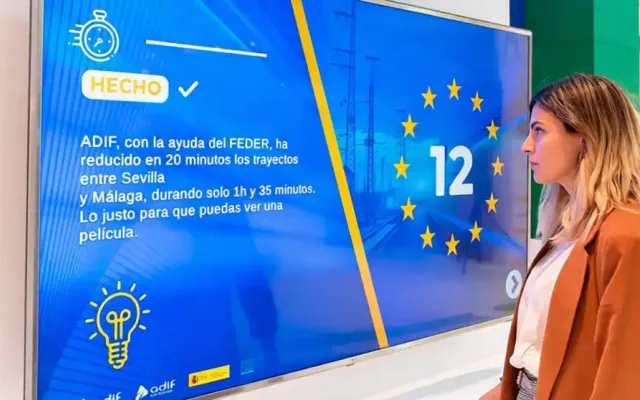
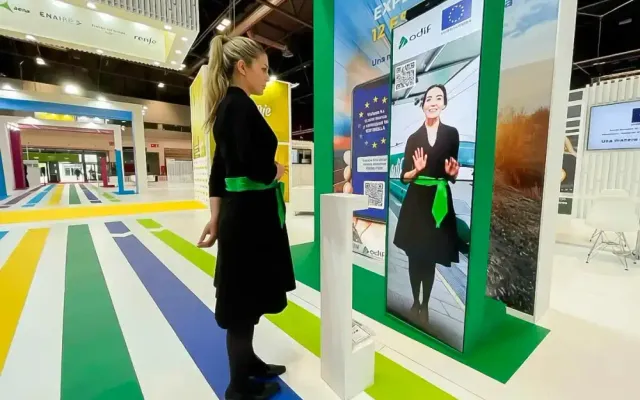
At the end of the aisle, one stand has a small crowd: a screen that responds, people playing and someone who, while waiting their turn, asks what the company actually does.
A well-designed interactive app is no longer an extra reserved for big budgets: it is the most direct way for a brand to be remembered, show what it knows and stand out from the competitor next door. And thanks to AI, it can now be developed with less friction and more control than just a few years ago.
What attendees expect in 2027
Amex GBT's 2027 Global Meetings and Events Forecast, published on 13 October 2026, is based on a YouGov survey of 500 meetings professionals in eleven countries. Improving the attendee experience is their top priority in every region. According to respondents, attendees expect more personalised experiences (35%), more social activities and networking (31%) and more hands-on, interactive sessions and workshops (31%).
Event Marketer's takeaways from IMEX America 2026, published on 16 October, point the same way. Many exhibitors lowered the pressure of talking to a stranger by giving visitors something to do with their hands while they chatted. And sponsors of activations outside the show floor could measure impressions, dwell time and how many people went on to visit the stand.
The practical conclusion is simple: attendees want to take part, not just watch. And what can be measured can be defended in front of the board.
Livening things up: making the aisle stop
An event app plays a different role depending on where it is used:
- On the stand, it draws people in from the aisle and gives them a reason to come closer without feeling cornered.
- In congress sessions, questions for speakers, live polls and quizzes keep the audience engaged and turn a talk into a conversation.
- In networking and sponsor areas, it creates a meeting point where waiting becomes part of the fun.
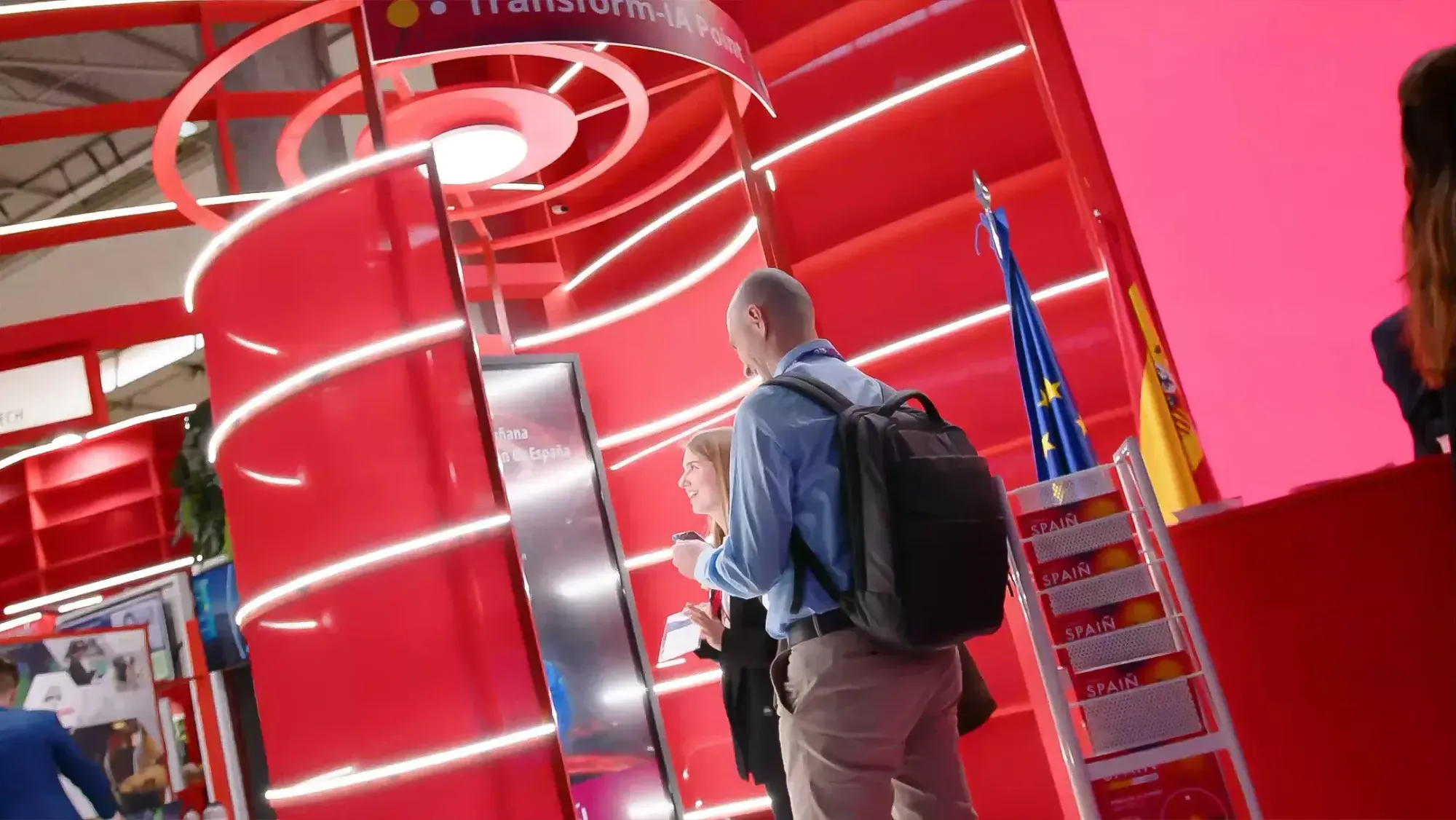
The key is that it reads from several metres away and that the first action is obvious. For Red.es we developed TransformIA, a custom Photo AI built into a metal booth in the corporate colour, framed by LEDs. Visitors take a photo and, in under 20 seconds, see themselves in futuristic settings: artificial intelligence explained without a single technical word. The experience has run in 2024, 2025 and 2026.
Authority: making sure visitors learn something from your brand
Entertainment is not enough. If visitors have fun but cannot remember who was behind it, the brand has simply paid for a show. Recognition comes when the mechanic serves the message: the game is the way in, and the content is what stays.
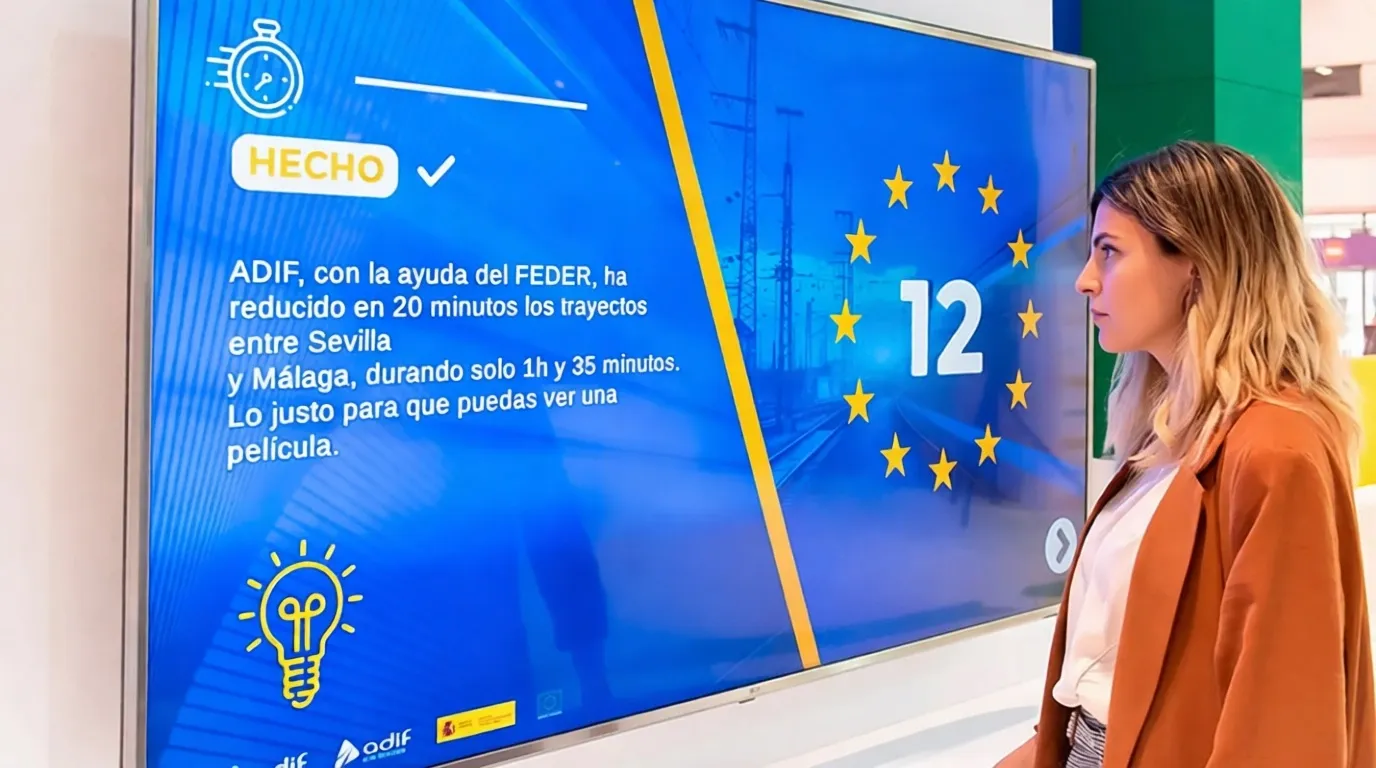
That is the idea behind the MITMA interactive quiz. Visitors answer questions, earn a star for every right answer and, depending on how many they collect, scan a QR code to claim their prize. Along the way, they discover the organisation's projects and achievements by playing, not by reading a panel.
For a brand, we propose the same pattern: questions that reveal an industry insight the company knows inside out, a demo in which visitors see for themselves how a product works, or a live poll whose results are discussed on stage. Whoever brings useful knowledge to an event becomes a point of reference; whoever only hands out merchandise does not.
Why it is more viable now than a few years ago
Not long ago, an interactive experience usually meant software built from scratch for a single event, installed on specific hardware and with little room for change. Three factors have made it more accessible:
- The web as a platform. A web app runs on the stand screen and on the attendee's phone, opened from a QR code with nothing to download.
- Reusable platforms. The technical core stays the same, while each event gets its own interface, styles and content.
- AI in development. It gets you to a playable prototype sooner, makes it easy to test interface variants and adapt copy to several languages, and frees time for what visitors actually notice.
WOMI, our own AI photo and video platform, follows that logic: it is quick to deploy, works with booths, kiosks or stand screens, and every client gets an interface and styles designed for their event.
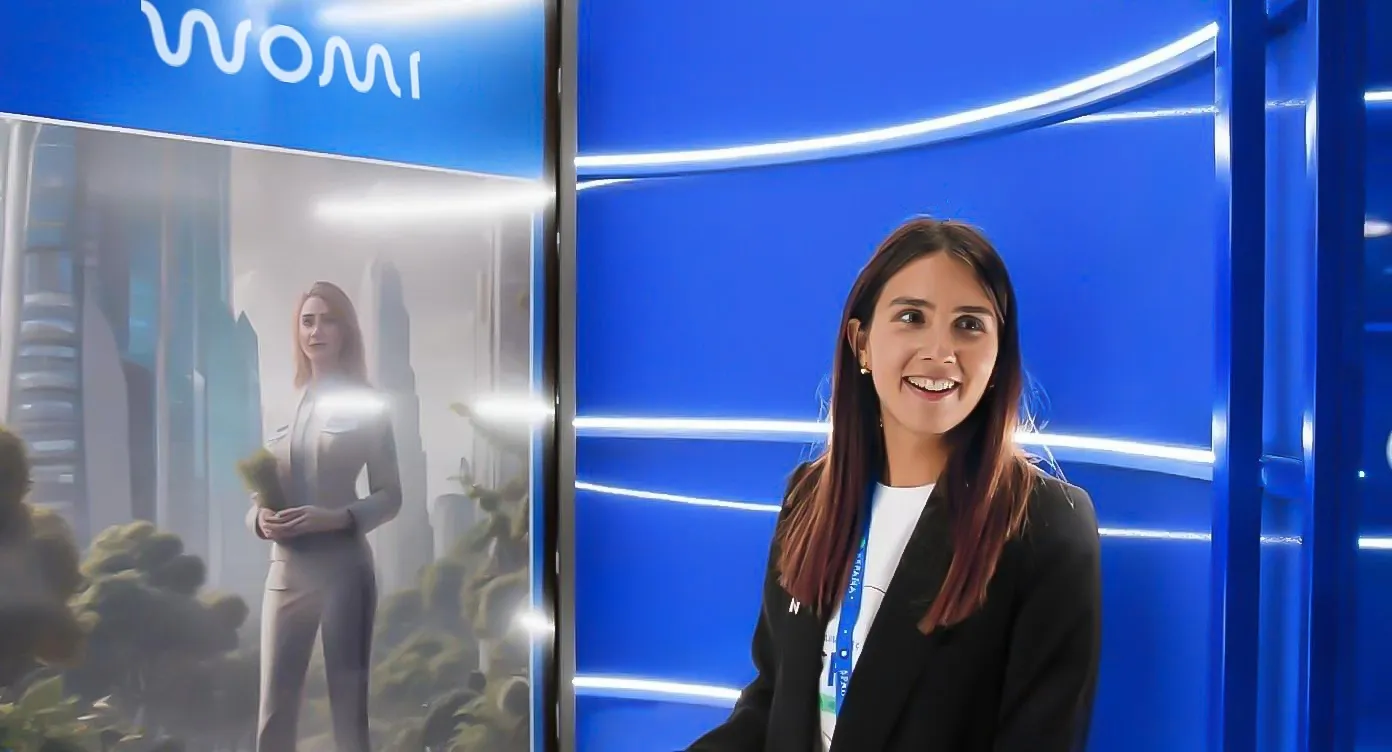
That reuse turns the app into an asset: it can travel to the next fair, adapt to another market or live on in the brand's website.
Faster is not enough: it has to be secure too
AI writing code quickly does not mean AI writing it well. Veracode's 2026 GenAI Code Security Report, published on 28 July 2026, found that roughly 44% of AI code generation tasks introduced a risky security vulnerability in its tests. The average security pass rate is 56%, barely changed from 55% in its first report, and for cross-site scripting it drops to 15%.
That last figure matters at events: questions for speakers or names on a leaderboard are audience-generated text that ends up on a big screen. So the advantage of AI lies not only in generating code but in reviewing it. We propose using it to audit code, write tests and simulate hundreds of simultaneous users, with a person deciding what goes into production. It is no coincidence that the Amex GBT forecast places risk management and compliance among the sector's top three priorities for 2027.
In an event app, security comes down to a few straightforward decisions:
- Ask only for the data you need, with clear consent: if a QR code is enough to deliver a photo, skip the form.
- Decide how long images are kept and who can access them.
- Moderate what is projected before it reaches the auditorium screen.
- Protect the admin panel with individual logins.
- Keep working offline when the venue Wi-Fi gives up, as we explained when writing about local-first applications.
How to approach the investment
Before talking about technology, we suggest this order:
- Set the brand objective: recall, qualified leads, training or a product launch.
- Choose a single core mechanic that anyone understands in seconds.
- Write the content that demonstrates expertise, not just the content that entertains.
- Test a prototype with real people before the event and watch where they hesitate.
- Measure what matters: dwell time, participation, consented contacts and shared content.
- Plan the app's second life: the next fair, another language, the website or the sales team.
In an aisle where every stand competes for the same minutes of attention, the brand that gets people involved is the one they remember. Waiting for the competition to move first usually means arriving late.
If you are preparing a trade fair, an event or a congress and want your brand remembered for what people experienced there, tell us your objective. We design and develop the whole experience, with technical and security judgement from day one.