
How to win a public tender with architectural visualization
Practical guide for architects and consulting firms: how to use 3D renders, animation, and interactive apps to score higher in public tenders and competitions in Spain.
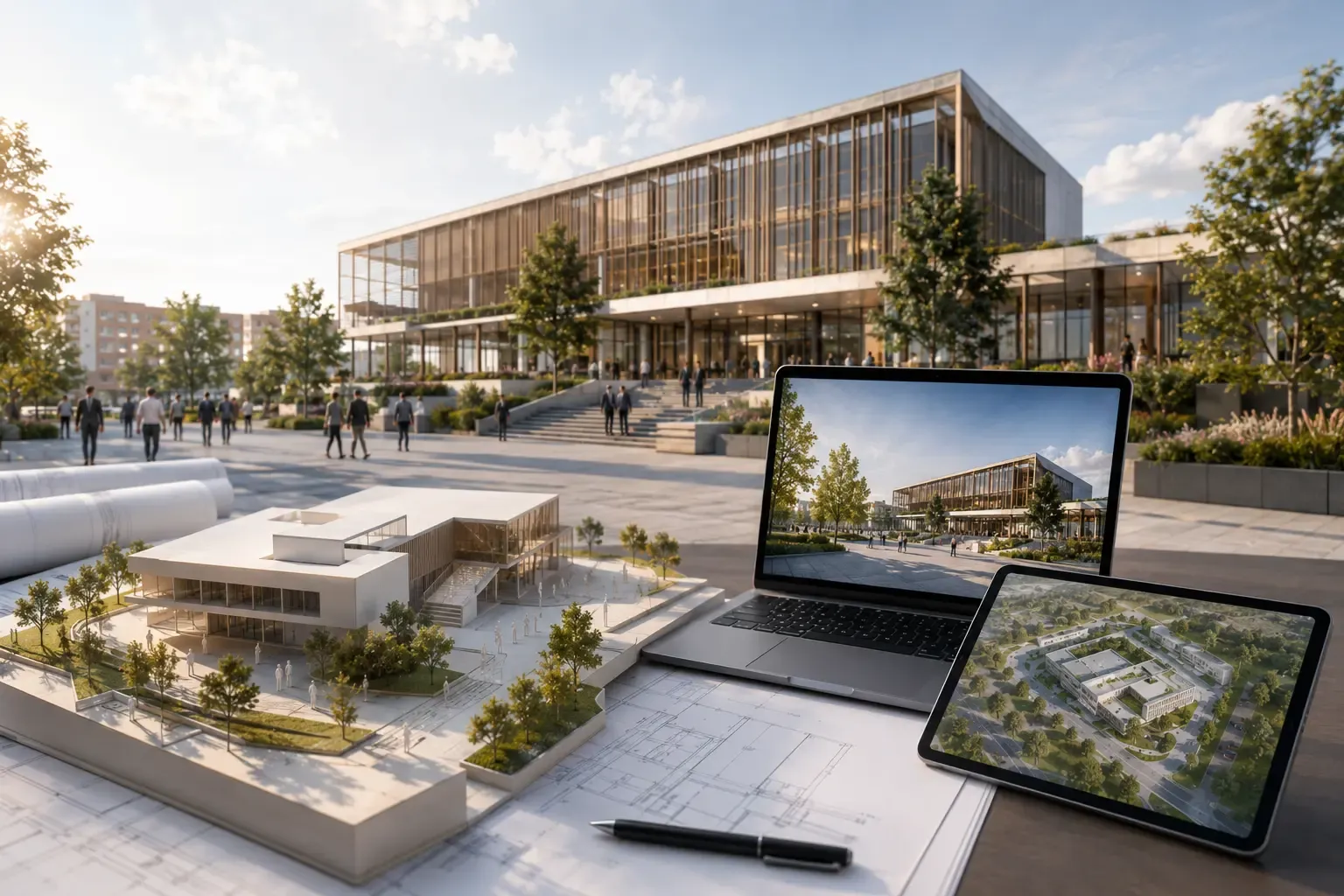
Winning a public tender in Spain is not just a matter of price. For years, the specifications of major calls—especially in infrastructure, urban planning, tourism, and public spaces—have included criteria for innovation, technical quality, and visual communication that can account for between 20% and 40% of the total score.
This is where high-level architectural visualization becomes a decisive competitive advantage.
In this article, we explain how to structure visual material to maximize your score in institutional tenders and competitions.
Why visualization matters in public tenders
Technical juries for public competitions receive dozens of proposals. Most present:
- Plans in AutoCAD or Revit
- Technical documents in PDF
- Basic renders or catalog renders
The proposals that stand out are those that manage to make the jury understand the proposal in 30 seconds and feel as though they can already see it built.
It is not an aesthetic detail. It is strategy.
A well-executed photorealistic render reduces the evaluator's cognitive friction. A 2-minute cinematic animation makes your proposal remembered when the jury deliberates between several similar options.
What visual material usually scores points in specifications
Every call is different, but in the highest-volume tenders in Spain (MITMA, ADIF, RED.es, Turespaña, capital city councils, ports), the sections that usually include visual criteria are:
Innovation criteria
This is where interactive apps, virtual reality, and augmented reality make a difference. Innovation specifications value:
- Use of advanced representation technologies
- Original digital tools for project presentation
- Ad-hoc software developed specifically for the proposal
If your competition presents static renders and you present an interactive app where the jury can navigate the proposal in real-time, the difference in scoring is substantial.
Technical quality and visual coherence
Renders and animations must be consistent with the scale of the project. Low-quality material in a major project generates distrust. Visual quality projects the technical quality of the team.
Presentation to the jury
In tenders with an oral phase, the quality of the presentation material—videos, large-format printed renders, screen animations—can be decisive.
Common mistakes in tenders that penalize visual scoring
1. Using generic or catalog renders
Non-customized renders communicate a lack of commitment to the project. The jury notices this.
2. Presenting low resolutions
Material printed in large format or projected in presentation rooms requires resolutions much higher than standard digital use. A pixelated 2K render in A0 printing detracts from credibility.
3. Not adapting the material to the real context
A render that does not reflect the real location, the built environment, or the site conditions loses points in suitability to the environment.
4. Ignoring technological innovation criteria
Many studios allocate their entire budget to static renders and none to the technology layer. In tenders with innovation criteria, this can cost between 10 and 30 points of the total score.
The winning combination: what to include based on the type of tender
Infrastructure and urban planning tenders
- High-resolution photorealistic renders (minimum 8K for printing)
- 60-90 second architectural animation with technical voiceover
- Presentation video for the oral phase
- Interactive digital model or project exploration app
Public facilities tenders (museums, cultural centers, institutional buildings)
- Interior and exterior render pack
- VR walkthrough for in-person presentation to the jury
- Interactive app with the conceptual and technical proposal
- Construction process animation (if valued by the specifications)
Tourism and territorial promotion tenders
- Audiovisual material adapted to different formats (web, social media, exhibition screens)
- Experiential apps for stands at international trade fairs (FITUR, WTM, ITB)
- Gamification and interactive dynamics for presentation events
How much time does visualization material for a tender need?
The most common mistake: leaving the visual part for the last days before submission.
A complete visualization pack for an average tender requires:
- High-resolution static renders: 1-2 weeks depending on complexity
- Architectural animation: 3-6 weeks
- Interactive app or VR: 4-8 weeks
The earlier the work with the visualization studio begins, the better the result and the greater the possibility of iteration and improvement.
Why choose a partner with experience in public tenders
Not just any visualization studio has experience in the specific context of public tenders in Spain. There are particularities:
- Understanding the technical criteria of the specifications
- Experience in presentations to technical and political juries
- Ability to adapt material to the required formats (delivery formats, resolutions, file types)
- Track record in projects with agencies such as MITMA, ADIF, RED.es, Turespaña
At Viseni, we have been working on high-level public tenders alongside architecture studios, consulting firms, and administrations for more than 10 years. We know the specifications, we understand the criteria, and we know what material makes the difference between a proposal that is forgotten and one that wins.
Do you have an upcoming tender? Tell us about the project and we will help you build the winning proposal.