
AI isn't coming to help you, it's coming to make companies more profitable
Automation is no longer looking to help you work better. It's looking for companies to need fewer people.
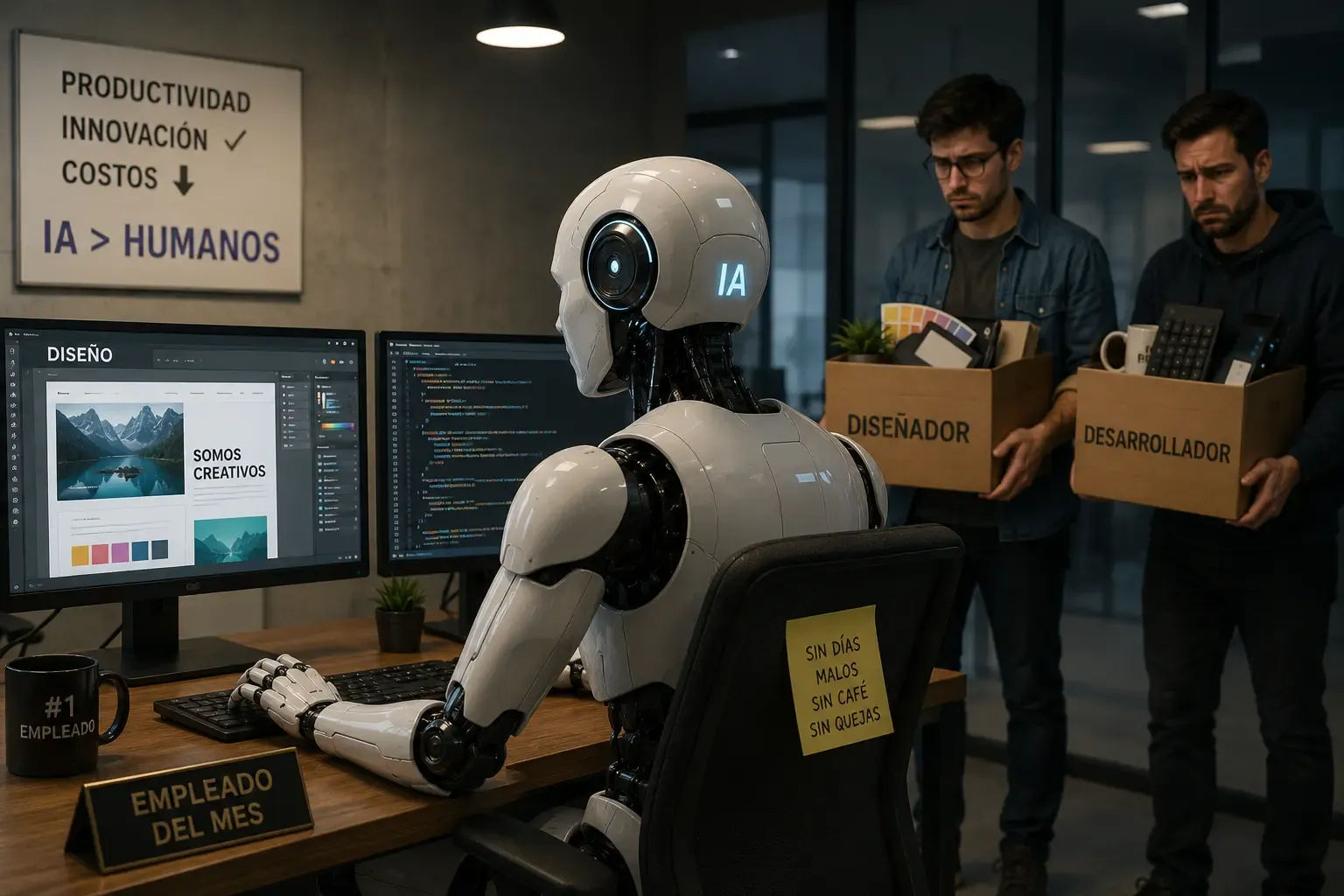
For years, we were sold artificial intelligence as a tool to enhance creativity, save time, and help us work better.
But most companies aren't going to use AI to look after you. They're going to use it to make more money.
And that completely changes the conversation.
The Question Is No Longer Technological
When a company discovers that a single person with AI can do the work of five, the question stops being technological and becomes financial. Because no board of directors is thinking about "how to maintain jobs." They are thinking about margins, efficiency, and growth.
AI doesn't collect a paycheck, doesn't get sick, and doesn't need vacations.
That's why the real impact won't be humanoid robots replacing entire offices. It will be much quieter.
They will simply stop hiring.
Especially junior profiles.
What AI Already Does in Seconds
Many of the entry-level tasks that used to serve for learning a trade are already handled by AI in seconds:
- Drafting texts and summarizing meetings
- Responding to emails and designing proposals
- Programming simple tasks or generating content
And that breaks something important: companies will have fewer and fewer incentives to train talent from scratch.
The Market That's Coming
The worrying part isn't that all jobs will disappear. It's that the market will become much more competitive.
- Fewer positions
- More people competing
- More pressure
- Lower salaries in many sectors
Meanwhile, companies that know how to integrate AI will operate with ridiculously small teams.
Agencies of five people will compete with companies of fifty. Freelancers will be able to produce like small production houses. And businesses that previously needed entire departments will now run with automations and two people supervising systems.
AI isn't just eliminating work. It's eliminating friction.
And when execution costs less, the market becomes ruthless.
The Opportunity No One Mentions
But here comes the uncomfortable part: this is also a huge opportunity for small businesses and freelancers.
For the first time, a single person can access capabilities that only large companies had before.
The difference is that working hard will no longer be enough. One must learn to multiply themselves.
Whoever continues to sell only hours and repetitive tasks will compete against software. And software always ends up being cheaper.
The real value will lie in judgment, strategy, personal branding, and the ability to solve problems that still need human context.
AI can generate content. But it still doesn't know how to build reputation. It can automate tasks. But it still doesn't deeply understand people.
Don't Sell Yourself Cheap
There is something no one will tell you and that you need to be clear about.
Learning to use these tools has a cost. Time, money, training, experience. You have assumed that cost. Not your client.
If you now produce more and better thanks to your investment, the beneficiary of that leap must be your business. Not the client who continues to pay the same as always.
Your client seeks their goal. You seek yours.
And your goal cannot be to impoverish yourself so that someone else gains more.
There will be a lot of competition, yes. But there will be huge differences between those who truly master these tools and those who simply use them without judgment. Between those who build more sophisticated services and those who only automate the superficial.
That difference is your margin. Don't give it away.
This Is Already Happening
The problem is that many people still see this as something far off. And it's not.
Companies are already using AI to produce more with fewer people. Not in ten years. Now.
The question is no longer whether AI will change the labor market. That has already begun.
The real question is something else:
Are you going to learn to use it to multiply your value?
Or are you going to compete against it?